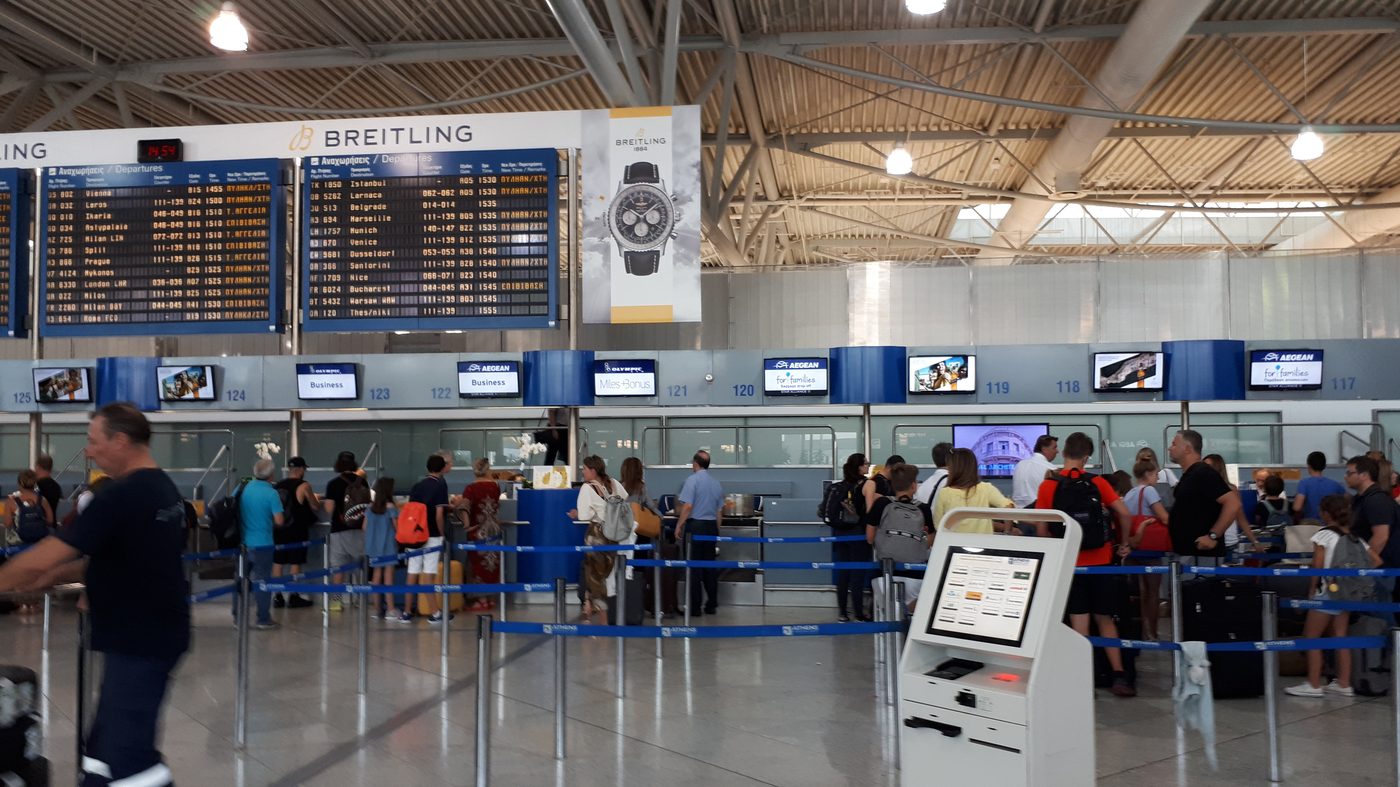
Athens International Airport sits 33 kilometres east of the city center, a distance that can be covered for as little as EUR 5.50 by bus or in as little as 40 minutes by metro or taxi, depending on budget and priorities.
In this guide
Getting from Eleftherios Venizelos Airport (ATH) to central Athens is straightforward, with several well-established transport links running throughout the day and, in the case of the airport buses, around the clock. Whether arriving on a morning flight and heading straight to a hotel near the Acropolis, or landing late at night and needing a reliable ride to Syntagma Square, there is an option that fits. This guide covers every method in detail (metro, bus, taxi, ride-hailing apps, private transfers, and car rental) with current prices, journey times, and where each one makes sense.
For anyone using Athens as a base for day trips, the transport choice on arrival day can set the tone for the entire trip. A traveller catching a morning ferry to Aegina or Hydra from Piraeus has different needs than someone checking into a city-centre hotel for a one-day Athens itinerary.
How Far Is Athens Airport From the City Center?
Athens International Airport is located near the town of Spata in eastern Attica, approximately 33 kilometres from Syntagma Square, the geographic and practical centre of tourist Athens. By road, the journey follows the Attiki Odos motorway (a toll road) and takes roughly 40 minutes in normal traffic conditions, though this can stretch to 60-75 minutes during the morning (07:30-09:30) and evening (17:00-20:00) rush hours.
The airport opened in 2001 and replaced the old Ellinikon Airport, which was much closer to the centre. The distance is the trade-off for a modern, well-connected facility. The good news is that the transport infrastructure has matured considerably since opening day: a direct metro line, four dedicated bus routes, suburban rail, and a well-regulated taxi system all serve the airport. For a detailed breakdown of the metro network beyond the airport line, see the Athens Metro Guide.
What Are Your Transport Options?
Here is a quick comparison of every option, with current prices as of 2025-2026:
| Method | Journey Time | Cost (EUR) | Best For |
|---|---|---|---|
| Metro (Line 3) | 40 min to Syntagma | 9.00 | Most travellers, reliable timing |
| Airport Bus X95 | ~60 min to Syntagma | 5.50 | Budget travellers, late-night arrivals |
| Airport Bus X96 | ~90 min to Piraeus | 5.50 | Ferry connections |
| Taxi | 40-60 min to centre | 50.00 (day) / 65.00 (night) | Comfort, groups, heavy luggage |
| Ride-hailing app | 40-60 min to centre | 50.00 (day) / 65.00 (night) | Cashless convenience |
| Private transfer | 40-60 min to centre | 60-90 | Families, meet-and-greet, peace of mind |
| Rental car | 40-60 min to centre | From ~35/day | Day trip flexibility |
How Does the Metro Work?
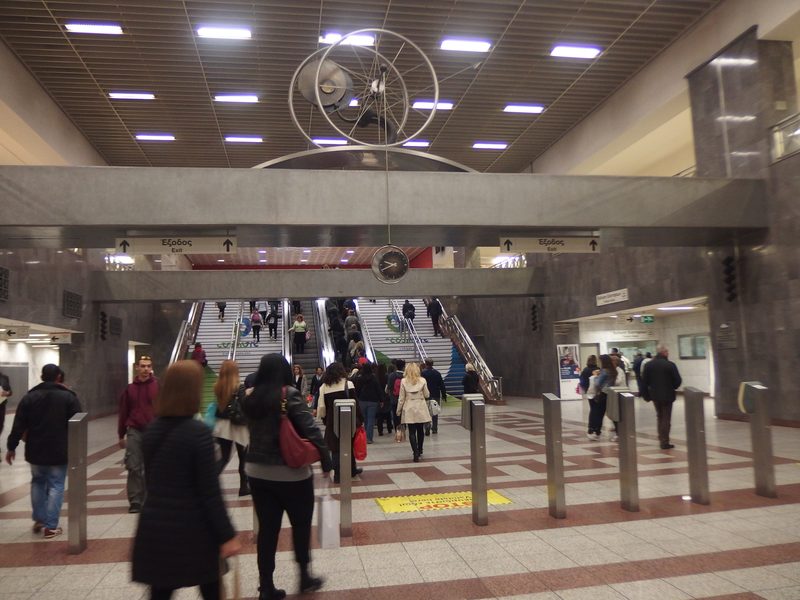
Metro Line 3 (the Blue Line) is the backbone of the airport-to-city connection and the option most visitors should default to. It runs directly from the airport to Syntagma Square in 40 minutes, continuing one stop further to Monastiraki (42 minutes). Both stations are in the heart of Athens.
Tickets and fares: A one-way airport metro ticket costs EUR 9 for adults. The reduced fare (children aged 7-12, students with valid ISIC card, over-65s) is EUR 4.50. Children under 6 travel free. A return ticket costs EUR 16 and is valid for 30 days, making it good value for a round trip. There is also a 3-day tourist ticket for EUR 20 that includes a return airport trip plus unlimited use of all Athens public transport (metro, buses, trams, and trolleybuses) for 72 hours. For anyone staying three or four days, this is the best deal available.
Contactless payment: Since January 2025, you can tap a contactless bank card or phone directly at the metro gates instead of buying a paper ticket. The airport fare of EUR 9 is charged automatically. This eliminates the need to queue at ticket machines on arrival.
Frequency and hours: Trains depart the airport every 36 minutes, running from approximately 06:10 until 23:34. This means the metro is not an option for very late-night or early-morning arrivals: the buses cover that gap.
Key stops en route: After leaving the airport, the metro passes through Pallini, Doukissis Plakentias, Halandri, and several other suburban stations before reaching central Athens. Important interchange stations include Doukissis Plakentias (connection to suburban rail), Ethniki Amyna, and Syntagma (connection to Line 2, the Red Line). From Syntagma, one stop further brings you to Monastiraki (connection to Line 1, the Green Line, which continues to Piraeus).
Luggage: The metro accommodates luggage without issue. Trains are modern, air-conditioned, and have sufficient standing room and overhead space. During peak commuting hours (roughly 07:30-09:30 and 17:00-19:30), carriages can be crowded, but the airport end of the line is less affected since most commuters board at intermediate stations.
Tip: If heading to the Plaka, Monastiraki flea market area, or anywhere near the Acropolis, ride to Monastiraki station rather than Syntagma. If heading to Kolonaki, Pangrati, or hotels along Vasilissis Sofias, Syntagma is closer.
What About the Airport Buses?
Athens runs four dedicated airport express bus routes, and their biggest advantage is that they operate 24 hours a day, 7 days a week. They are the only public transport option that does.
X95, Airport to Syntagma Square: This is the route most visitors want. It runs directly from the airport to Syntagma, taking approximately 60 minutes in normal traffic (longer during rush hour). Buses depart roughly every 20-30 minutes during the day and every 40 minutes overnight.
X96, Airport to Piraeus Port: Essential for anyone catching a ferry immediately after landing. The journey takes about 90 minutes and drops passengers at the main Piraeus port area. If arriving in Athens specifically for a Saronic islands cruise or a ferry to Poros or Spetses, this bus avoids the need to transit through central Athens. Departures every 20-25 minutes.
X93, Airport to Kifissos Bus Terminal (KTEL): Useful for travellers connecting to intercity buses heading to the Peloponnese, western Greece, or northern Greece. The journey takes about 65 minutes. If planning an onward trip to Delphi, Meteora, or Nafplio, note that bus terminal assignments vary by destination, so check which KTEL terminal your route uses before boarding. Departures every 40 minutes.
X97, Airport to Elliniko Metro Station: Connects to the southern suburbs and the Red Line (Line 2). Less commonly used by tourists unless heading to the southern Athens Riviera coast. Departures every 40-60 minutes.
Fares: All airport bus routes cost EUR 5.50 one-way (EUR 2.70 reduced). You can buy tickets from the driver, at kiosks near the bus stop, or simply tap a contactless bank card when boarding. The bus stop at the airport is located between Exits 4 and 5 on the Arrivals level, clearly signposted.
When to choose the bus: The X95 is the clear choice for arrivals between midnight and 06:00 when the metro is not running. It is also the cheapest public transport option at EUR 5.50. The downside is journey time: at 60+ minutes, it is significantly slower than the metro, and in heavy traffic it can take 90 minutes or more. The buses also make multiple stops along the route, so the ride is less direct.
How Much Does a Taxi Cost?
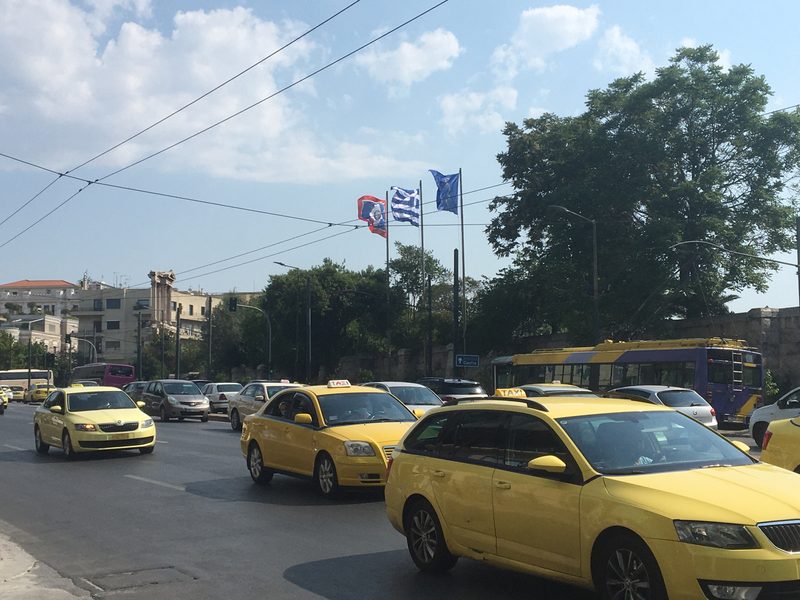
Taxis from Athens Airport operate on a government-regulated flat fare, which removes the uncertainty that plagues airport taxi rides in many other cities.
The fixed rates: EUR 50 from 05:00 to midnight, EUR 65 from midnight to 05:00. These fares apply to any destination within the Athens city centre ring (roughly bounded by Kifissia to the north, Piraeus to the south, and Glyfada to the southeast). The rate is determined by the time of arrival at the destination, not departure from the airport.
What is included: The flat fare covers everything: tolls on the Attiki Odos motorway, luggage surcharges, airport pickup fee, and VAT. There are no legitimate extras. If a driver claims additional charges, they are in the wrong. By law, drivers must provide a receipt.
Where to find taxis: Official taxis queue at Exit 3 on the Arrivals level. The queue is managed and generally orderly, though waits of 15-20 minutes are common during peak arrival times (particularly late morning when many European flights land). Athens taxis are yellow and licensed. Avoid anyone approaching inside the terminal offering "taxi" rides.
Journey time: Around 40 minutes in light traffic, potentially 60-75 minutes during rush hours. The motorway section is fast; the bottleneck is usually the final approach through city streets.
When to choose a taxi: Taxis make the most sense for groups of 2-4 people (splitting EUR 50 four ways is EUR 12.50 each, not much more than the metro), for travellers with heavy or bulky luggage, for families with small children, or when arriving during rush hour and wanting to avoid standing on a crowded metro. At EUR 50, the premium over the metro is modest by European standards.
Should You Use a Ride-Hailing App?
Three ride-hailing apps operate in Athens: FREENOW (the most popular locally, formerly known as Beat/TaxiBeat), Uber (which operates as Uber Taxi using licensed taxi drivers), and Bolt (which launched in Athens in January 2025).
All three apps dispatch licensed Athens taxis, which means the same flat airport fares apply: EUR 50 during the day, EUR 65 at night. The price advantage over hailing a taxi from the queue is zero. The real advantages are convenience and transparency: cashless payment, a tracked route, a driver assigned before pickup, and no need to communicate in Greek. Uber pickups are at the controlled zone opposite Exit 4-5 on the Arrivals level.
Bolt frequently runs promotions for new users, which can occasionally shave a few euros off the fare. FREENOW tends to have the most drivers available at any given time. Uber is familiar to most international visitors.
A practical note: during very busy arrival periods, app-based taxis can sometimes take longer to arrive than simply joining the taxi queue at Exit 3. If the queue is short, the old-fashioned approach may be faster.
Should You Book a Private Transfer?
Private transfers are pre-booked car services where a driver meets you in the arrivals hall holding a sign with your name, helps with luggage, and drives you to your accommodation. Several companies operate at Athens Airport, including Welcome Pickups, GetYourGuide transfers, and various local operators.
Typical prices: EUR 60-75 for a standard sedan (up to 4 passengers), EUR 75-90 for a minivan (up to 7 passengers). Sedan rates usually run about EUR 9-12 above the taxi fare. The minivan option is where private transfers offer genuine value: no standard Athens taxi can comfortably fit more than 4 people plus luggage.
What you get for the money: Flight monitoring (the driver adjusts for delays), a meet-and-greet in the terminal, a known English-speaking driver, no waiting in a queue, and often a brief introduction to the city during the drive. Some services include bottled water and phone chargers.
When it makes sense: Private transfers are worth considering for families with children and car seats (some providers supply them on request), groups of 5-7 needing a minivan, first-time visitors who want a smooth and stress-free start, and late-night arrivals when the taxi queue may be thin. They are also useful when heading to a specific accommodation outside the centre, such as hotels along the Athens Riviera coast or near Cape Sounion, where metered taxi rates rather than flat fares would apply.
When it does not make sense: Solo travellers or couples on a budget who are comfortable with public transport. The metro gets you to the centre for EUR 9, and a private transfer for EUR 60+ is hard to justify unless convenience is the priority.
Is Renting a Car Worth It?
All major international rental agencies (Hertz, Avis, Europcar, Sixt, Enterprise) and several local companies operate desks at Athens Airport. Picking up a car on arrival is straightforward.
When renting makes sense: If the Athens trip is primarily about day trips to places that are difficult to reach by public transport (Mycenae and Nafplio, Ancient Nemea, Monemvasia, the Nemea wine region, or Schinias Beach at Marathon), then having a car from day one eliminates the need for separate transport arrangements. A car also opens up multi-stop itineraries that would be impractical by bus: combining Ancient Corinth with the Corinth Canal and a swim at a Peloponnese beach, for example, or linking Delphi with Arachova in a single day.
When it does not make sense: If planning to stay in central Athens for most of the trip, a car is a liability. Parking in central Athens is difficult and expensive (street parking is scarce, hotel parking costs EUR 15-25 per night, and public garages near Syntagma charge EUR 2-3 per hour). Traffic in the centre is congested and confusing for visitors. The one-way system around the Acropolis and Plaka is particularly unforgiving. For island day trips via ferry from Piraeus, the metro is simpler and cheaper.
Typical costs: Expect EUR 35-60 per day for a compact car in shoulder season, rising to EUR 50-80 in July-August. Book well in advance for peak season. Fuel costs are approximately EUR 1.70-1.90 per litre. Tolls on the Attiki Odos from the airport to the centre are around EUR 3 (included in taxi flat fares but paid separately when driving).
A middle-ground approach: Many day trippers rent a car for just 2-3 days of excursions and rely on the metro and ferries for the rest. Several agencies offer pickup and drop-off at central Athens locations as well as the airport, so it is possible to arrive by metro, explore Athens car-free, then pick up a rental for a Peloponnese road trip before returning it and catching the metro back to the airport.
Are There Any Money-Saving Tips?
A few fare strategies can reduce transport costs, particularly for longer stays. For broader savings advice covering accommodation, food, and sightseeing, see the Athens on a budget guide.
The 3-day tourist ticket (EUR 20) is the best deal for most visitors. It includes a return airport trip (normally EUR 18 if buying two one-way metro tickets) plus unlimited use of all Athens public transport for 72 hours. If planning to use the metro or buses even a few times during a stay, it pays for itself immediately. Available at airport metro ticket machines and staffed booths.
The return metro ticket (EUR 16) saves EUR 2 compared to buying two singles, and is valid for 30 days. Useful for those not planning to use much urban transit beyond the airport transfer.
Contactless payment at EUR 5.50 (bus) or EUR 9 (metro) means no need to find a ticket machine or carry exact change. Simply tap and go. The system charges the correct airport fare automatically when entering at the airport station.
Group taxi economics: For 3-4 people travelling together, a EUR 50 taxi (EUR 12.50-17 per person) is only marginally more expensive than individual metro tickets (EUR 9 each) and far more convenient with luggage. It is also faster. The taxi becomes the obvious choice for any group of three or more.
Which Option Is Best for Day Trippers?
For readers of this site, people using Athens as a base to explore the surrounding region, the transport choice from the airport depends on what comes next.
Heading straight to a ferry? Take the X96 bus directly to Piraeus (EUR 5.50, ~90 min). This makes sense if arriving on a morning flight and catching an afternoon ferry to Aegina, Agistri, or the other Saronic Islands. Alternatively, take the metro to Monastiraki, change to Line 1 (Green Line), and ride to Piraeus, faster but requiring a transfer.
Checking into a city-centre hotel first? The metro to Syntagma or Monastiraki is the default. Quick, predictable, and avoids traffic. From either station, most central hotels are within a 10-15 minute walk or a short taxi ride. Our self-guided walking tour starts from Syntagma if you want to hit the ground running.
Arriving late at night? The X95 bus to Syntagma runs all night. A taxi at the EUR 65 night rate is the comfortable alternative.
Planning car-based day trips? Pick up a rental at the airport and drive directly to your hotel, or, if the timing works, skip the city entirely and head straight to Cape Sounion or Marathon from the airport. Both are closer to the airport than to central Athens.
Travelling with kids? A family trip with car seats, strollers, and tired children is one situation where a pre-booked private transfer with a minivan genuinely earns its premium. Dragging luggage and children through the metro at rush hour is nobody's idea of a good start to a holiday.
The bottom line: the metro handles most situations well. It is fast, affordable, and immune to Athens traffic. Save the taxi or transfer for when comfort, group size, or unusual logistics justify the extra cost. And whichever option you choose, you will be exploring Athens or boarding a ferry to the islands within the hour. For help planning what comes next, see the five-day Athens itinerary, the best museums in Athens, or the Athens food tours guide. And before you pack, check what to pack for Athens.
Athens Airport is well connected to the city center by metro (EUR 9, 40 min), express bus (EUR 5.50, 60 min, 24/7), and taxi (EUR 50 flat rate). The metro is the best option for most travellers; the bus wins for late-night arrivals and tight budgets; taxis and transfers earn their place for groups, families, and anyone who values door-to-door convenience.
Planning more adventures from the capital? Browse our complete guide to the best day trips from Athens.
Last updated: 28 September 2026