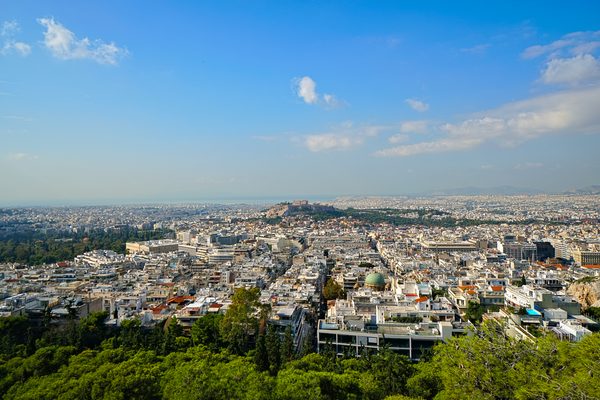
This walking route covers approximately 6 kilometres through the historic centre of Athens, linking 13 stops from Syntagma Square to the backstreets of Psyrri. Allow 4-6 hours at a comfortable pace, or a full day if you enter the ticketed sites. It is the best way to see ancient and modern Athens on foot, without a guide and without a tour bus.
In this guide
Athens is a city that makes sense when you walk it. The major archaeological sites, the old neighbourhoods, the squares where Athenians actually spend their time. They are all clustered within a surprisingly compact area, and the connections between them tell the story of the city better than any museum panel. This route threads through that core, moving roughly in a loop from the political centre at Syntagma through the ancient sites and old town, ending where most visitors want to end up: somewhere with cold beer and good food.
The route works in any season, though summer visitors should start early and carry water. It is mostly flat, with two uphill sections (Anafiotika and Areopagus) that are short but steep. You do not need to enter any ticketed site to enjoy the walk (every stop on this route offers something worth seeing from the outside), but two or three are worth paying for if time and budget allow.
What Does This Walking Tour Cover?
The route begins at Syntagma Square and moves south through the National Garden to the Panathenaic Stadium, then loops back through the Temple of Olympian Zeus and into the old Plaka neighbourhood. From there it climbs briefly into Anafiotika, drops down past the Roman Agora, crosses Monastiraki Square, and continues to the edge of the Ancient Agora. The final stretch takes in Areopagus Rock and Filopappou Hill before ending in Psyrri for lunch or drinks.
Total walking distance is about 6 kilometres, not counting detours into sites. The terrain is a mix of pedestrianised streets, park paths, marble steps, and a few short stretches of pavement alongside traffic. Comfortable shoes with grip are essential: several surfaces are polished marble that becomes treacherous when wet.
If you are working with a one-day itinerary or two days in Athens, this walking route can serve as the skeleton. Add or subtract ticketed sites depending on your time.
Where Should You Start?
Syntagma Square is the natural starting point. It is the political and geographic heart of modern Athens, served by two metro lines (blue and red), and virtually every bus route in the city passes through or near it. If you are coming from elsewhere in Attica, the Athens metro guide covers connections.
The square faces the Hellenic Parliament building, formerly the Royal Palace, and the Tomb of the Unknown Soldier at its base. This is where the walk begins, and where you catch the first spectacle of the day.
The Route: Stop by Stop
Stop 1: Syntagma Square and the Changing of the Guard
The Evzones (the presidential guards in their distinctive pleated kilts, white stockings, and pom-pom shoes) perform a changing of the guard ceremony at the Tomb of the Unknown Soldier every hour, around the clock, every day of the year. The standard ceremony takes about 10 minutes and involves two guards, their slow-motion choreographed march, and the sharp crack of their shoes on the marble.
The ceremony worth timing your visit for is the grand Sunday parade at 11:00, when a full company of Evzones in white ceremonial dress marches down Vasilissis Sofias Avenue accompanied by a military band. It lasts about 30 minutes and draws a large crowd. Arrive by 10:40 to secure a good vantage point near the Tomb.
On any other day, simply check the time and wait for the next hourly change. It is free to watch and genuinely impressive: the precision and solemnity of the ritual are striking even if you have seen similar ceremonies elsewhere.
Practical notes: The square has cafes, ATMs, and public transport connections. There is no shade at the Tomb itself, so in summer the wait can be hot.
Time here: 15-30 minutes.
Stop 2: National Garden
From the Tomb of the Unknown Soldier, turn right and walk along the front of the Parliament building. After about 100 metres you will reach the entrance to the National Garden on your left, through a gate on Vasilissis Amalias Avenue.
The National Garden is 15.5 hectares of shade, ponds, and winding paths, a genuine relief in a city that can feel relentlessly built-up. It was originally the Royal Garden, planted in the 1840s with over 500 species of plants brought from around the world. Today it is slightly overgrown in a way that feels more like a forest than a formal park, which is part of its charm.
Cut through the garden heading south. There is no single correct path. Any route through will eventually bring you to the southern exit on Irodou Attikou or Vasileos Konstantinou Avenue. The walk through takes about 10-15 minutes. Along the way, look for the small duck pond, the botanical museum (free, usually empty), and the mosaic floor fragments near the Zappeion.
You will emerge near the Zappeion, a neoclassical exhibition hall with a pleasant cafe terrace. The Panathenaic Stadium is visible from here, directly ahead across Vasileos Konstantinou Avenue.
Time here: 10-15 minutes (walking through).
Stop 3: Panathenaic Stadium (Kallimarmaro)
Cross Vasileos Konstantinou Avenue and you are facing the Panathenaic Stadium: the only stadium in the world built entirely of marble, and the site where the first modern Olympic Games were held in 1896. The horseshoe-shaped structure sits in a natural hollow between two hills, and even from the outside it is immediately clear why Athenians call it Kallimarmaro: "the beautiful marble."
The stadium was originally built in 330 BC for the Panathenaic Games and reconstructed in marble by Herodes Atticus in 144 AD. What you see today is the 1896 reconstruction funded by Georgios Averoff, whose statue stands at the entrance.
You can see the stadium well from the road without paying, particularly from the bridge on Vasileos Konstantinou where you get the classic head-on view into the open end. But if you want to walk on the track, sit in the marble seats, and visit the small Olympic museum underneath, the entry fee is EUR 10 (EUR 5 for students and over-65s). The ticket includes an audio guide in 11 languages. Children under 6 enter free.
The best photo spot is from the pedestrian bridge directly opposite the open end of the stadium. You get the full sweep of marble seats with the Acropolis visible on the hill behind.
Time here: 15 minutes from outside, 30-45 minutes if you enter.
Stop 4: Temple of Olympian Zeus and Hadrian's Arch
From the stadium, walk back along Vasileos Konstantinou Avenue heading northwest. After about 500 metres (7-8 minutes), you will reach the corner of Vasilissis Amalias and Vasilissis Olgas Avenues. Hadrian's Arch stands right at this intersection, and the Temple of Olympian Zeus is immediately behind it.
Hadrian's Arch is a Roman gateway built in 131 AD to mark the boundary between the ancient Greek city and the new Roman quarter built by Emperor Hadrian. It stands in a small traffic island, free to walk up to and photograph. The inscriptions on each side are worth reading: one says "This is Athens, the ancient city of Theseus" and the other "This is the city of Hadrian, and not of Theseus."
Behind the arch, the Temple of Olympian Zeus, or what remains of it, is visible through the fence. Fifteen Corinthian columns still stand from what was once the largest temple in Greece, with 104 columns in total. The sheer height of the remaining columns (17 metres each) gives a sense of the scale that no photograph captures properly. One toppled column lies where it fell in a storm in 1852, its drums scattered like a fallen stack of coins.
Entry to the site is EUR 20, but the temple is perfectly visible from the pavement on Vasilissis Olgas Avenue. Unless you are particularly drawn to the site, save your ticket money for the Ancient Agora later.
Time here: 10-15 minutes.
Stop 5: Plaka
From the Temple of Olympian Zeus, walk northwest along Lysikratous Street. After 200 metres you will pass the Choragic Monument of Lysicrates on your right, a small but beautiful circular marble monument from 334 BC that is easy to miss if you are not looking for it. This street feeds directly into the heart of Plaka.
Plaka is the oldest continuously inhabited neighbourhood in Athens, draped over the northern and eastern slopes of the Acropolis. Its neoclassical houses, many dating from the 18th and 19th centuries, line narrow pedestrian streets that feel like a different city from the concrete blocks just a few hundred metres away.
The main commercial street is Adrianou, which runs roughly east-west and is lined with restaurants, souvenir shops, and cafes. It is pleasant enough for a stroll but not where the real character of Plaka lives. For that, turn off Adrianou and head uphill on any of the smaller streets: Mnisikleous, Erechtheos, or Kydathineon. These climb through quieter residential areas where the only sounds are birdsong and the occasional conversation drifting from a balcony.
What to skip: The restaurants on lower Adrianou with laminated photo menus and staff beckoning you inside. They serve acceptable but overpriced tourist food. Save your appetite for Psyrri at the end of the walk, or book an Athens food tour to find the places that matter.
What not to skip: A Greek coffee at one of the small kafeneia on the stepped streets above Adrianou. Also, the Church of Panagia Gorgoepikoos (Little Metropolis), a tiny 12th-century Byzantine church tucked next to the much larger Athens Cathedral on Mitropoleos Square. It is built partly from ancient marble fragments, and the carved reliefs on its exterior are a jumble of classical, early Christian, and medieval motifs.
Time here: 20-40 minutes, depending on how much you wander.
Stop 6: Anafiotika
From upper Plaka, continue uphill toward the Acropolis. Look for a narrow staircase near the Church of the Metamorphosis of the Saviour (Sotiras) on Theorias Street. This is the entrance to Anafiotika, and it is deliberately easy to miss.
Anafiotika is a tiny settlement of about 45 houses clinging to the rocky north slope of the Acropolis, and it looks nothing like the rest of Athens. White-washed walls, blue doors, narrow stepped paths barely wide enough for two people, bougainvillea spilling over every surface, cats on every step. It looks like a Cycladic island village, and that is exactly what it is, or was. In the 1840s and 1850s, builders from the small island of Anafi were brought to Athens to construct King Otto's palace. Homesick and resourceful, they built a miniature version of their island village on the only unclaimed land available: the steep slope beneath the Acropolis walls.
A Greek law dating from Ottoman times said that if you could build a house between sunset and sunrise, you could keep it. The Anafiotes exploited this loophole, and the neighbourhood survived multiple attempts to demolish it. Today about 45 houses remain, most still inhabited.
Wander through for 15-20 minutes. Do not rely on GPS. It is useless here. The paths twist and dead-end without logic, which is the point. You will eventually emerge on the western side, heading downhill toward Monastiraki.
Time here: 15-20 minutes.
Stop 7: Roman Agora and Tower of the Winds
Descend from Anafiotika through Plaka heading northwest. You will come out near the intersection of Pelopida and Eolou streets, where the Roman Agora is visible behind a low fence.
The Roman Agora was the commercial centre of Athens under Roman rule, built between 19 and 11 BC with funding from Julius Caesar and Augustus. Most of what remains are column bases and the outline of a colonnaded marketplace, but two structures stand out.
The Gate of Athena Archegetis, at the western entrance, is a substantial four-column gateway still standing to nearly full height. The Tower of the Winds (Aerides), at the eastern end, is an octagonal marble clocktower from the 1st century BC that served as a sundial, water clock, wind vane, and compass simultaneously. It is one of the best-preserved ancient structures in Athens and, after a recent restoration, looks remarkably sharp.
Both are clearly visible from outside the fence on Pelopida and Eolou streets. Entry to the Roman Agora site is EUR 8 in summer, EUR 4 in winter, but for this walk, the view from outside is sufficient.
Time here: 5-10 minutes.
Stop 8: Monastiraki Square and Flea Market
Continue northwest along Eolou or Adrianou Street for about 200 metres and you will arrive at Monastiraki Square, one of the busiest and most atmospheric intersections in Athens.
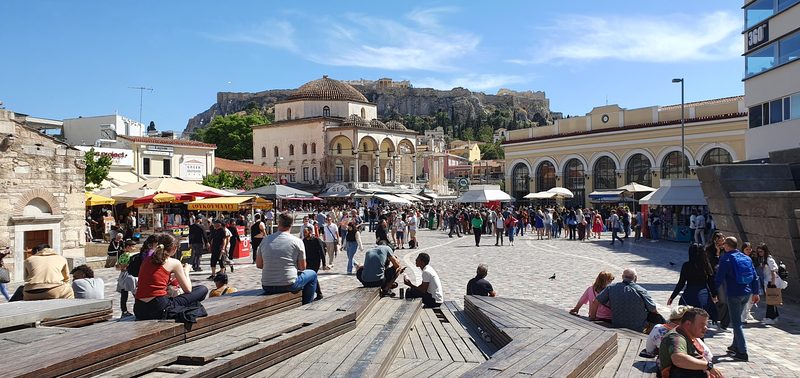
The square is a crossroads of eras. The small Church of the Pantanassa (10th century) sits in the middle. The Tzistarakis Mosque (18th century, now a ceramics museum) faces it. The excavated ruins of Hadrian's Library (a massive Roman-era complex that once housed reading rooms, a pool, and a garden) are visible through the fence just to the north. Behind everything, the Acropolis looms on the hill above.
From the square, Ifestou Street leads south into the flea market. On weekdays this is a string of shops selling leather goods, handmade sandals, worry beads, antiques of variable authenticity, and vintage curiosities. On Sundays the market expands onto the surrounding streets and gets considerably more chaotic, and more interesting. Expect old cameras, vinyl records, military surplus, furniture, and objects that defy categorisation.
Monastiraki is also a metro station (blue and green lines), so this is a natural point to end the walk if you are running short on time or energy.
Time here: 15-30 minutes.
Stop 9: Ancient Agora (Optional Ticketed Entry)
From the southwest corner of Monastiraki Square, walk south along Adrianou Street for about 150 metres. The entrance to the Ancient Agora is on your left.
The Ancient Agora is where Athenian democracy was born, where Socrates argued with anyone who would listen, and where the daily business of the ancient city took place for over a thousand years. It is less dramatic than the Acropolis but arguably more interesting, because this is where ordinary life happened.
Two structures justify the EUR 10 entry fee. The Stoa of Attalos, a two-storey colonnaded building reconstructed in the 1950s by the American School of Classical Studies, houses an excellent museum of everyday Athenian objects: ostracism ballots, drinking cups, children's toys, a kleroterion (the device used to randomly select jurors for trials). The Temple of Hephaestus, sitting on a low hill at the western edge, is the best-preserved classical Greek temple in the world. Where the Parthenon is a famous ruin, the Temple of Hephaestus still has its roof, its columns, and most of its sculptural decoration intact. It is the closest thing in Athens to seeing a Greek temple whole, and it gets a fraction of the Acropolis crowds.
If you are choosing which ticketed sites to enter on this walk, the Ancient Agora is the one. It is also shaded by olive trees and far cooler than the exposed Acropolis, which matters on a summer afternoon.
If you prefer not to enter, the Temple of Hephaestus is partly visible from Adrianou Street, and the Stoa of Attalos can be seen from several vantage points around the perimeter.
Tickets: EUR 10 (Apr-Oct), EUR 5 (Nov-Mar). Free for EU citizens under 25.
Time here: 45-90 minutes if entering, 5 minutes from outside.
Stop 10: Areopagus Rock
From the Ancient Agora entrance, walk south along the pedestrianised Apostolou Pavlou Street, keeping the Acropolis hill on your left. After about 300 metres, you will see a metal staircase on your left leading up to a large exposed rock. This is Areopagus, also called Mars Hill.
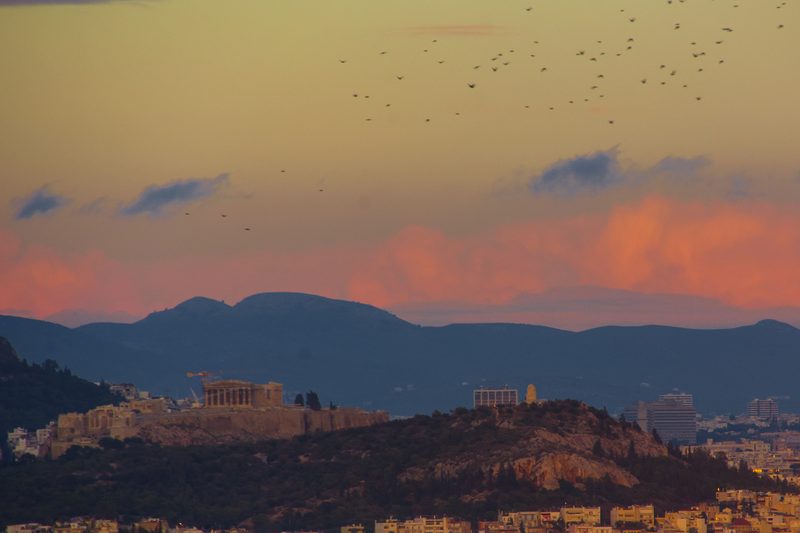
Areopagus is free to climb and offers one of the finest viewpoints in Athens. From the top, the Agora spreads out below you, Monastiraki and the modern city stretch to the north, Filopappou Hill rises to the southwest, and the Acropolis walls tower directly above. At sunset, when the marble of the Parthenon turns gold and then pink, this is where half of Athens comes to sit.
In ancient times, Areopagus was the site of Athens' oldest court, where murder trials were held under the open sky. It is also where the Apostle Paul delivered his famous sermon to the Athenians (Acts 17), and a bronze plaque at the base quotes the text in Greek.
A serious warning about the surface: The marble on Areopagus has been polished smooth by millions of feet over thousands of years. It is genuinely dangerous when wet and slippery even when dry if you are wearing smooth-soled shoes. People fall here regularly. Wear shoes with grip, take the metal staircase rather than scrambling up the rock face, and be extremely careful near the edges: there are no railings.
Time here: 15-30 minutes.
Stop 11: The Acropolis (Optional)
The entrance to the Acropolis is a short walk uphill from Areopagus, heading east along the path that skirts the north side of the hill. The main (west) entrance is well signed.
Whether you enter depends on your priorities. The Acropolis is the defining monument of Western civilisation, and if this is your first time in Athens, you should probably go. The Parthenon, the Erechtheion with its Caryatid porch, the Propylaia gateway, and the Temple of Athena Nike are all up there, along with views that stretch to the sea on clear days.
But if you have already visited, or if it is midday in July and the idea of an exposed hilltop with no shade sounds punishing, it is completely legitimate to skip it on this walk and return early the next morning when the light is better and the crowds are thinner. The walk works perfectly well without entering the Acropolis.
Tickets: EUR 30 (year-round). Timed entry required. Book in advance at tickets.hh.gr. Slots fill up in peak season, sometimes days ahead.
Hours: 8:00-20:00 (Apr-Oct), 8:00-17:00 (Nov-Mar). Last entry 30 minutes before closing.
Time here: 1.5-2 hours if entering. Skip if you have been before or if you are wilting.
For a detailed breakdown of the Acropolis visit, see the one-day Athens itinerary.
Stop 12: Filopappou Hill
From Areopagus, walk southwest along Apostolou Pavlou Street for about 200 metres. A path on your right leads uphill into the pine-covered slopes of Filopappou Hill (also written Philopappos).
Filopappou is the Acropolis viewpoint that most tourists miss. It is quieter, greener, and arguably offers a better view of the Acropolis than any other spot in the city, because you see the entire rock and every monument on it framed against the sky. There is a marble viewing platform near the top with benches. This is the classic postcard angle.
The hill is named after Gaius Julius Antiochus Epiphanes Philopappos, a Roman-era Syrian prince who loved Athens enough to be buried here. His funerary monument, built in 116 AD, stands at the summit: a curved marble facade with relief sculptures.
Multiple paths lead to the top. The gentlest route follows the paved path from Apostolou Pavlou Street; the steepest cuts straight up through the trees. Either way, the climb takes about 10-15 minutes. There is no entry fee and no opening hours: the hill is a public park, accessible at all times.
If you enjoy walking in nature close to the city, Mount Hymettus offers a more substantial hike with views over all of Athens and the Saronic Gulf.
Time here: 20-40 minutes.
Stop 13: Psyrri, Lunch and the End of the Walk
From Filopappou Hill, walk back to Apostolou Pavlou Street and continue north. The street becomes Thissio as it passes the metro station of the same name. Continue along Ermou Street heading east for about 400 metres, then turn left into the backstreets of Psyrri. The walk from Filopappou to Psyrri takes about 15 minutes.
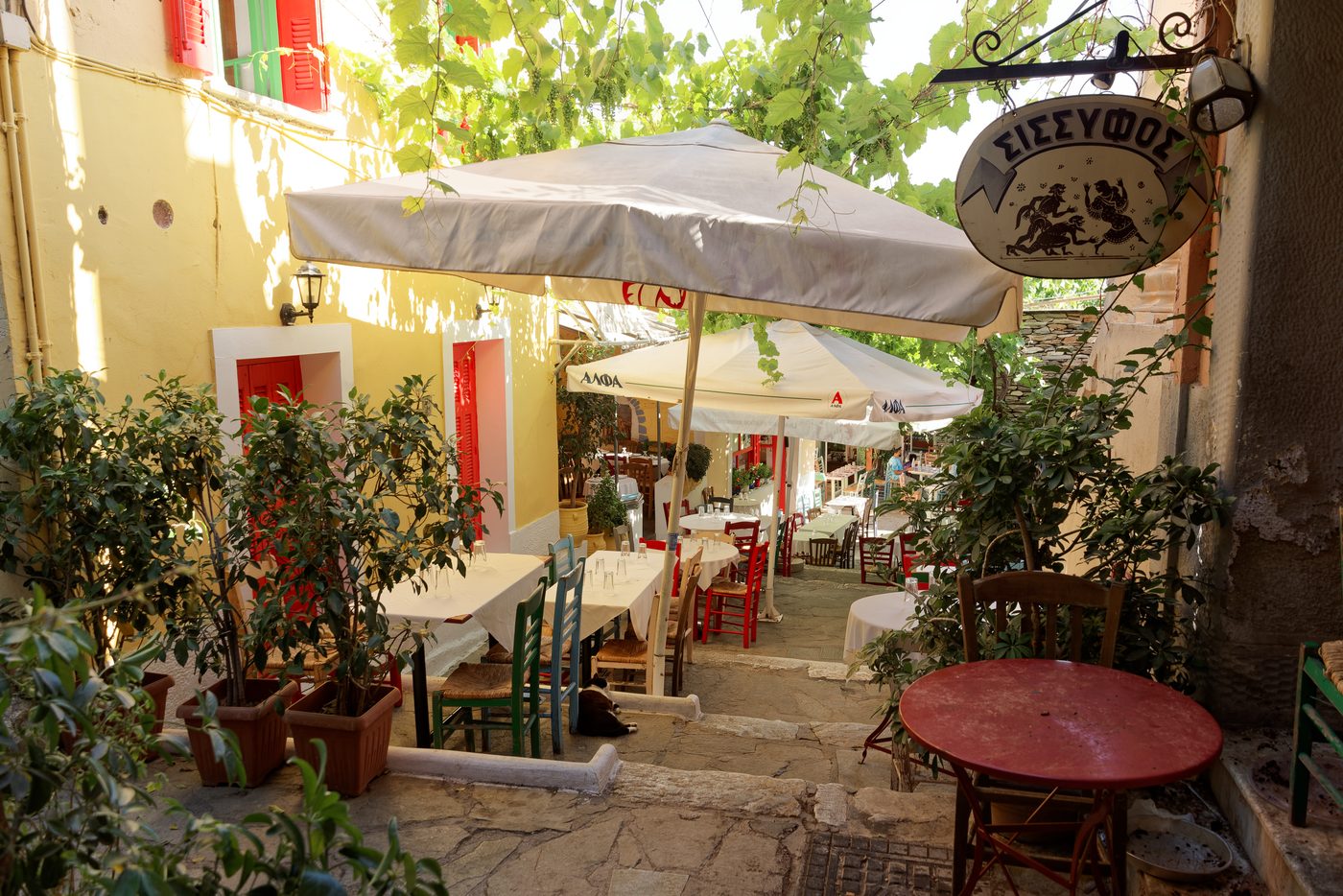
Psyrri is the old workshop and warehouse district of Athens, and over the past two decades it has become the most interesting eating and drinking neighbourhood in the centre. The streets between Ermou and Evripidou are filled with small tavernas, mezedopolia, wine bars, and craft cocktail spots. Unlike Plaka, the clientele here is mostly Greek, and the prices reflect it.
For souvlaki, the cluster of shops around Plateia Agia Irini (a small square with a flower market) is where Athenians go for a quick, cheap lunch. For a sit-down meal, the backstreets of Psyrri have excellent options at every price point. For a more structured food experience, an Athens food tour typically includes several stops in this area.
Psyrri also connects directly to Monastiraki (5 minutes south) and Omonia (10 minutes north), both of which are metro stations. If you still have energy, the best museums in Athens are mostly within walking distance from here.
Time here: As long as you want. You have earned it.
How Long Does the Walk Take?
Three pacing options:
Rushed (3 hours): Walk the route without entering any ticketed sites. Pause briefly at each stop for photos and orientation. This is tight but doable if you are a fast walker who just wants the highlights.
Comfortable (4-6 hours): The recommended pace. Enter one or two sites (the Ancient Agora is the best value), linger in Plaka and Anafiotika, spend 20 minutes on Areopagus. Stop for coffee somewhere along the way.
Full day (7-8 hours): Enter the Acropolis, the Ancient Agora, and the Panathenaic Stadium. Climb Filopappou Hill at sunset. Have a long lunch in Psyrri. This turns the walk into a comprehensive day out.
When Is the Best Time to Do This Walk?
Start between 08:00 and 09:00 in any season. In summer (June-September), this is critical: by 11:00 the unshaded sections become genuinely unpleasant, and by midday the marble at the Acropolis and Areopagus can reach temperatures that burn through thin shoes. An early start means you reach Plaka and its shaded streets before the worst of the heat.
In spring (April-May) and autumn (October-November), timing is less critical and the light is beautiful all day. These are the best months for this walk: warm enough for comfort, cool enough for sustained walking, and significantly fewer crowds than summer. For more detail on seasonal planning, see best time to visit Athens.
Winter (December-February) is perfectly viable. Athens rarely drops below 8-10 degrees Celsius, rain is intermittent rather than persistent, and the reduced tourist numbers mean you can actually see the monuments without fighting through crowds. Some outdoor sites close earlier (17:00 instead of 20:00), and several have reduced winter admission fees.
If you want to catch the Sunday changing of the guard ceremony (11:00), plan to start the walk at Syntagma at around 10:30 and adjust the rest of the route accordingly.
What Should You Bring?
Water. At least one litre per person, more in summer. There are kiosks and shops along the route, but the uphill sections (Anafiotika, Areopagus, Filopappou) have no shade and no vendors.
Shoes with grip. This is not optional. The marble on Areopagus, the stone steps in Anafiotika, and the paths around the Acropolis are polished, uneven, and slippery. Sandals and smooth-soled shoes are a genuine hazard. Trainers or hiking shoes with rubber soles are ideal.
Sun protection. Hat, sunscreen, sunglasses. Large sections of this walk are fully exposed, and Athens sun reflects off marble and white buildings with real intensity.
A charged phone. For navigation between stops and for photos. Download an offline map of Athens before you start. GPS can be unreliable in the narrow streets of Anafiotika and Plaka.
Cash. Most cafes and kiosks accept cards, but the smaller market stalls in Monastiraki and some traditional kafeneia in Plaka are cash-only. A EUR 20 note covers incidentals.
If you are visiting Athens on a budget, this walk is one of the best free activities in the city: the entire route can be done without spending a cent on admission, and many of the most memorable moments (Anafiotika, Areopagus at sunset, the changing of the guard) cost nothing.
This route covers the essential historic centre of Athens in a single walk, from Syntagma Square to Psyrri, with 13 stops that span 2,500 years of history. It works as a standalone day out or as the framework for a longer stay.
Planning more adventures from the capital? Browse our complete guide to the best day trips from Athens.
Last updated: 1 October 2026