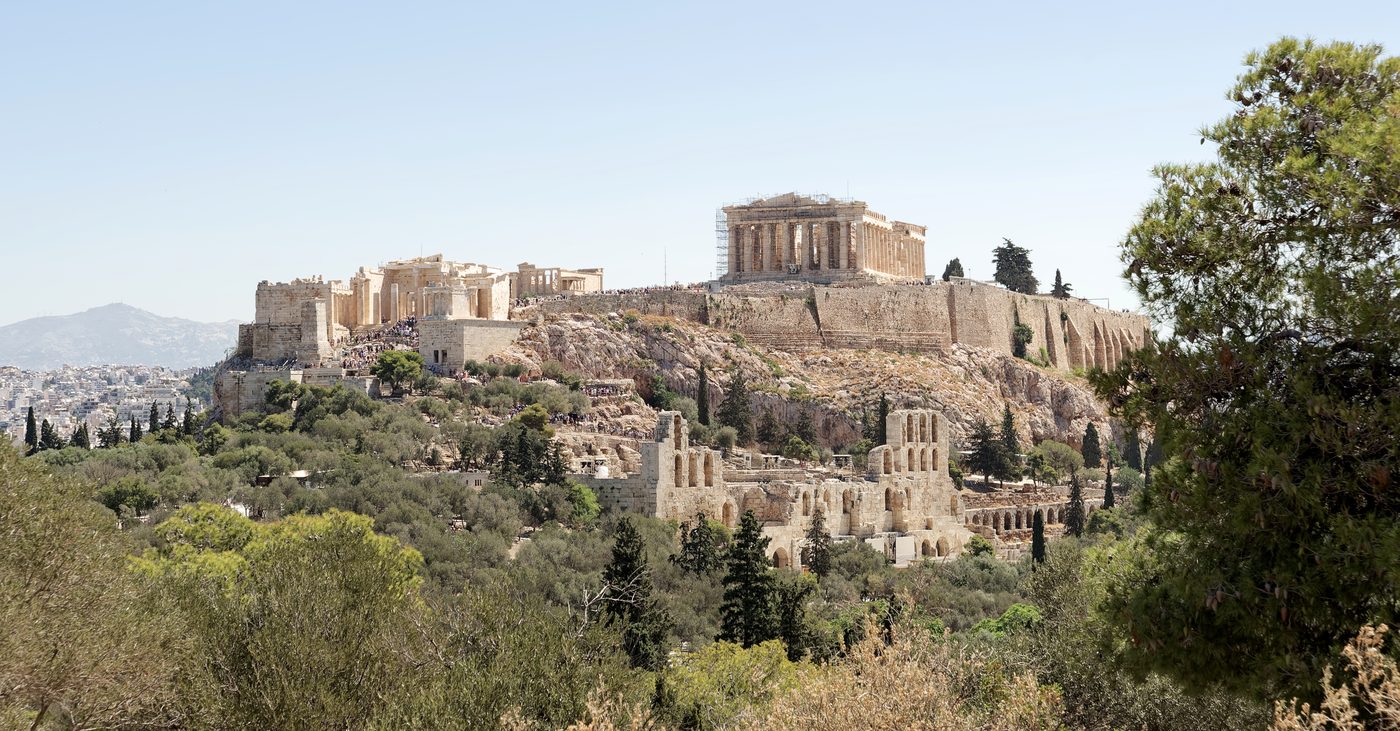
Five days is the number that unlocks Athens properly. Two days in the city lets you move at a human pace: lingering in museums, discovering neighbourhoods that tour buses never reach. Three days beyond the city limits lets you experience the ancient sites, islands, and landscapes that make Athens one of the great base camps in European travel.
In this guide
Most visitors give Athens two or three days before rushing to the islands. They see the Acropolis, eat in Plaka, and leave thinking they have seen Greece. They have not. With five days, you can stand inside the Parthenon Gallery watching morning light move across the frieze, climb Lycabettus Hill at golden hour, ferry to a car-free island for lunch, walk the Sacred Way at Delphi where the Oracle once spoke, and wander the Venetian streets of Nafplio, Greece's most beautiful small town. This itinerary is not a stretched version of a shorter trip. It is built from scratch for five days, balancing intensity with rest, antiquity with coastline, and Athens with the places that Athens makes possible.
How Should You Structure Five Days in Athens?
The split is simple: two days in the city, three days out. Athens has enough to fill a week, but the day trips from this city are so exceptional that spending more than two days inside the urban core means missing the real prize.
Here is the overview:
| Day | Focus | Highlights |
|---|---|---|
| Day 1 | Ancient Athens | Acropolis, Acropolis Museum, Plaka, Ancient Agora, evening in Psyrri |
| Day 2 | Museums, neighbourhoods, hidden Athens | National Archaeological Museum, Exarchia, Kolonaki, Lycabettus sunset |
| Day 3 | Saronic Island escape | Hydra, Aegina, or the three-island cruise |
| Day 4 | Delphi | The Oracle's sanctuary, Delphi Museum, Arachova village |
| Day 5 | Nafplio and the Peloponnese | Nafplio old town, Mycenae or Epidaurus |
The order matters. Days 1 and 2 build your understanding of Greek civilisation from the ground up. Day 3 provides a physical and mental reset: sea air, no agenda, slower rhythms. Days 4 and 5 take you to the mainland sites that put Athens in context: the religious centre of the ancient world, the fortress-city of Agamemnon, and the town that served as the first capital of modern Greece.
Day 1: The Ancient City
Morning: The Acropolis (08:00--10:30)
Arrive before the gates open. The security queue forms by 07:45 in summer, but these early arrivals are rewarded with something close to silence on the Sacred Rock: footsteps on marble, wind through the Propylaea, and the Parthenon emerging in full morning light before the crowds arrive.
Enter from the south slope rather than the main western approach. The path is steeper but the queue is shorter, and you approach the summit from an angle that reveals the full length of the Parthenon's south colonnade: 46 outer columns receding into perspective. Notice the platform bowing gently upward at the centre. Combined with the slight inward lean of every column, these optical corrections make the building appear perfectly straight from a distance. Engineering in service of illusion, calculated 2,500 years before computers.
Walk the full circuit to the Erechtheion and its Caryatid porch. The maiden figures are casts, but the originals wait for you in the museum below. At the eastern edge, look down at the Theatre of Dionysus, where Sophocles and Euripides staged the plays that invented Western drama.
Tickets: 30 EUR year-round. Timed entry is mandatory. Book your slot in advance at tickets.hh.gr. Entry is by hourly time slot and daily visitor numbers are capped. Summer slots sell out. For a deeper look at fitting this into a tighter schedule, see the one day in Athens itinerary.
Late Morning: Acropolis Museum (10:30--12:30)
The Acropolis Museum sits at the base of the south slope, and with five days in Athens, there is no reason to rush through it. Start on the ground floor, where glass panels reveal an excavated ancient neighbourhood beneath the building, where ordinary people lived, cooked, and traded in the shadow of the Parthenon.
The Archaic Gallery on the first floor holds the korai, marble maidens still carrying traces of the original pigment: red lips, blue drapery, painted eyes. The Peplos Kore, displayed alongside her digitally reconstructed painted version, permanently demolishes the myth of monochrome Greek antiquity.
The top-floor Parthenon Gallery is the emotional core. Surviving frieze sections are mounted in their original positions around a room oriented to match the Parthenon itself. Where the British Museum's portions belong, white plaster casts fill the gaps. The absence speaks for itself.
Tickets: 20 EUR. No advance booking required for individuals. Allow 1.5--2 hours.
Lunch: Plaka and Anafiotika (12:30--14:00)
Walk north from the museum into Anafiotika, the tiny Cycladic village clinging to the Acropolis's north slope: whitewashed houses, stepped lanes, bougainvillea, cats. Built by workers from the island of Anafi in the 19th century, it takes twenty minutes to wander through and most visitors walk straight past it.
Descend into Plaka for lunch. Yes, Plaka is touristy, but the back streets off Kydathinaion still have tavernas where a Greek salad, grilled halloumi, and a beer run 12--16 EUR. Avoid the restaurants with photos on the menu and laminated multilingual cards. Walk one street deeper instead. For a structured route through these streets, the self-guided walking tour of Athens covers the best of them.
Afternoon: The Ancient Agora (14:30--16:30)
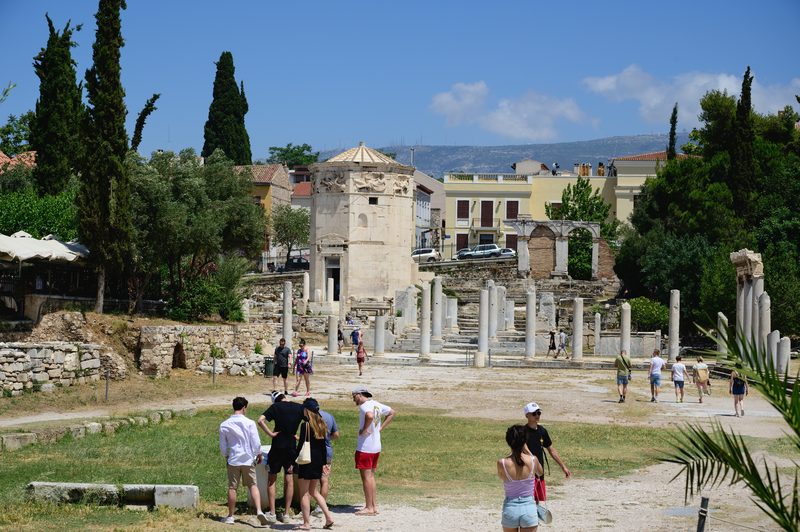
The Agora was the beating heart of Athenian democracy: the marketplace, law courts, and civic centre where Socrates argued, citizens voted, and merchants haggled. It is less dramatic than the Acropolis but arguably more important to understanding how Athens actually worked.
The Stoa of Attalos, reconstructed in the 1950s, houses the Agora Museum: bronze ballots, jury tokens, a child's potty seat, an ancient alarm clock (a water clock with a siphon). These everyday objects are more revealing than any temple. The Temple of Hephaestus, the best-preserved classical Greek temple in existence, stands on the western hill. Its roof is intact. Its columns are complete. It is what the Parthenon looked like before 2,500 years of earthquakes, explosions, and looting.
Tickets: 10 EUR. Enter from Adrianou Street or from the Monastiraki metro exit.
Late Afternoon: Monastiraki and the Flea Market (16:30--18:00)
Walk east from the Agora into Monastiraki Square, where the Ottoman-era Tzistarakis Mosque faces the metro station and the Acropolis rises behind every photograph. The streets south toward Avyssinias Square are the flea market: antique dealers, junk shops, vintage records, copper pots, Byzantine icons. Weekdays are quieter; Sundays bring the full bazaar.
Evening: Psyrri (19:30 onwards)
The streets north of Monastiraki around Psyrri have shifted from edgy to established but remain more interesting than Plaka at night. Small plates, natural Greek wines, grilled meats at street-side tables. Dinner with wine: 25--35 EUR per person. The courtyard bars on Pittaki Street, lit with donated chandeliers strung between buildings, are worth finding.
Day 2: Museums, Neighbourhoods, and Hidden Athens
Morning: National Archaeological Museum (09:00--12:00)
Twenty minutes north on foot from Omonia, or metro to Victoria. This is the most important collection of Greek antiquities on earth, and it needs a proper morning. Do not try to see all 50 rooms. Here is what matters.
Room 4, Mycenaean Collection: The Mask of Agamemnon, beaten gold death masks, inlaid daggers, the Vapheio Cups decorated with bull-catching scenes. Whether the famous mask depicts the legendary king is debatable; its power is not.
Room 15, The Bronze Poseidon (or Zeus): A life-sized figure mid-throw, recovered from a shipwreck in 1928. One of the tiny number of original Greek bronzes to survive antiquity. This single statue justifies the museum.
Room 38, The Antikythera Mechanism: The world's first known analogue computer, built around 100 BC. A corroded lump of bronze gears that tracked the sun, moon, five planets, and predicted eclipses. Nothing of comparable complexity appeared for over a thousand years.
The Cycladic Collection: Marble figurines from the 3rd millennium BC: abstract, minimalist, hauntingly modern. Brancusi and Modigliani drew direct inspiration from them.
Tickets: 20 EUR (reduced 10 EUR). Allow 2.5--3 hours. For the full museum guide, see best museums in Athens.
Lunch: Exarchia (12:00--13:30)
Walk east from the museum into Exarchia, Athens's anarchist-intellectual quarter. The plateia is ringed with cheap, excellent restaurants: mezedes, oven-baked dishes behind glass, barrel wine. Full lunch for 10--14 EUR. This is where students, artists, and academics eat, and the prices reflect it. The vinyl record shops and independent bookstores on the surrounding streets are worth browsing.
Afternoon: Kolonaki and the Benaki Museum (14:00--16:00)
From Exarchia, walk south through the university campus to Kolonaki, the upscale quarter beneath Lycabettus Hill. The contrast is deliberate. Anarchist murals to designer boutiques in fifteen minutes. Athens contains multitudes.
The Benaki Museum of Greek Culture on Vasilissis Sofias is manageable in 90 minutes and covers Greek civilisation from prehistory to the 20th century through a superb private collection. Tickets 12 EUR. Or, for something different, try the Museum of Cycladic Art nearby (8 EUR), which expands on the figurines you saw this morning.
Late Afternoon: Lycabettus Hill Sunset (17:30--19:30)
The funicular runs from the top of Ploutarchou Street in Kolonaki (7 EUR return) to the summit, 277 metres above the city. The walk up takes 30--40 minutes through pine forest if you prefer to earn the view. Either way, arrive 45 minutes before sunset.
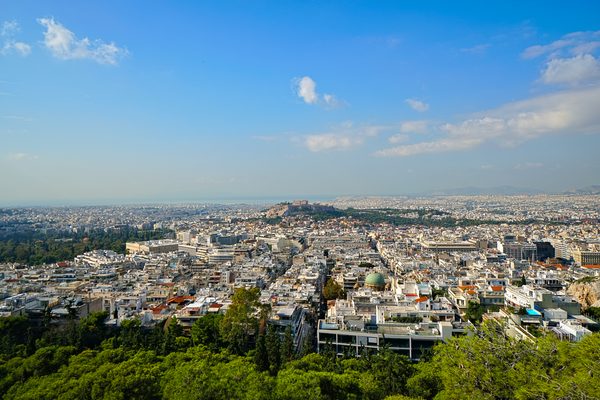
From the top: the Acropolis directly below, the Saronic Gulf beyond, and on clear days, the mountains of the Peloponnese on the horizon. As the sun drops, the city shifts from white to gold to amber, and the floodlights on the Parthenon snap on. This is the single best viewpoint in Athens, and it is not close.
The small chapel of Agios Georgios and the open-air theatre (summer only) sit at the summit. The cafe is overpriced but the experience is free. Bring water and a snack.
Evening: Koukaki or Petralona (20:00 onwards)
Skip the tourist circuit for your last evening in the city. Koukaki, south of the Acropolis, has become Athens's best dining neighbourhood: modern Greek cooking, wine bars, small plates. Petralona, slightly further west, is earthier: lamb chops, horta with lemon, a bottle of Nemean red at a corner taverna. Dinner for two with wine: 40--55 EUR. For a deeper dive into the food scene, see Athens food tours.
Day 3: Saronic Island Escape
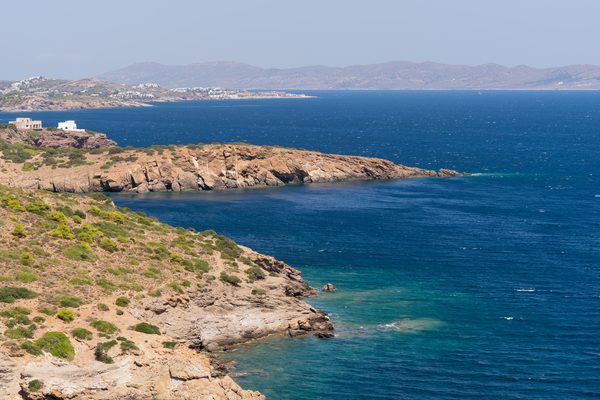
After two days of walking ancient ruins and city streets, the body needs salt water and the brain needs space. The Saronic Gulf islands are close enough for a day trip and different enough to reset your entire rhythm.
Option A: Hydra (Recommended for Independent Travellers)
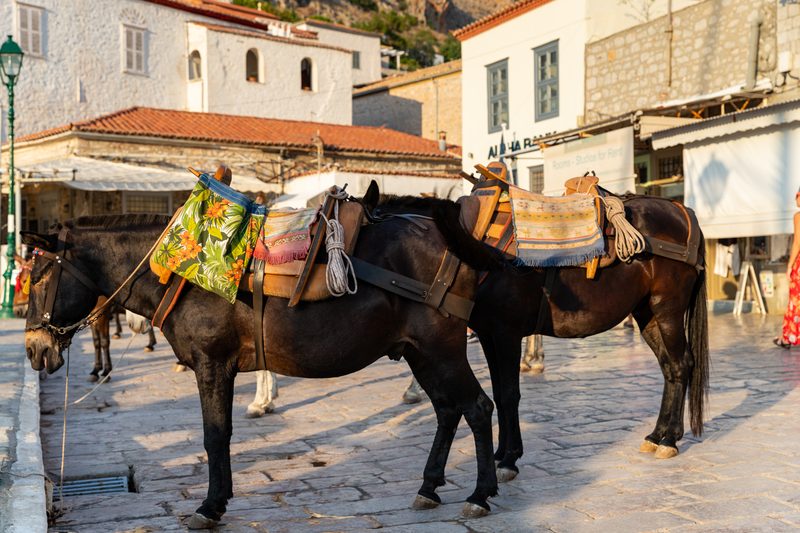
No cars, no motorbikes, no construction cranes. Hydra banned motor vehicles decades ago, and after two days in Athens the stillness is almost disorienting. The harbour opens as the ferry rounds a headland: a crescent of grey stone mansions, fishing boats at anchor, cafe tables on the quay.
Getting there: Metro Line 1 to Piraeus (25 minutes from Monastiraki), then high-speed ferry from Gate E8/E9. The crossing takes 70 minutes to two hours, costing 30--42 EUR each way. Book in advance during summer weekends. For the complete logistics, see the Athens to Hydra day trip guide.
What to do: Walk the back lanes into the steep stone stairways and whitewashed captains' mansions. Visit the Historical Archive Museum for the island's extraordinary role in the Greek War of Independence. Swim at Kaminia (15 minutes on foot) or take a water taxi to Vlychos (5 minutes, 10--15 EUR). Grilled octopus at a harbourside taverna. Return on the 17:00--19:00 ferry.
Option B: Aegina (Best for History + Beach)
Closer, cheaper, and underrated. Aegina is 40 minutes by fast ferry and has both the superb Temple of Aphaia (one of the best-preserved Doric temples in Greece) and pistachio-farming villages with none of Hydra's boutique prices. See the Aegina day trip guide for the full breakdown, or consider combining it with a stop on Agistri, the tiny pine-covered island next door.
Option C: Three-Island Cruise (Best for First-Timers)
The classic Saronic islands cruise visits Hydra, Poros, and Aegina in a single day. It is not cheap (around 100--130 EUR per person including lunch) and you get limited time on each island, but it solves all logistics and gives a sampler of three distinct island characters. Pickup from central Athens hotels is usually included.
For more island options, Poros makes an excellent standalone day trip as well.
Day 4: Delphi, Centre of the Ancient World
This is the day trip that visitors remember for years. Delphi sits on the slopes of Mount Parnassus at 600 metres elevation, overlooking a valley of olive trees that runs down to the Gulf of Corinth. For over a thousand years, it was the most important religious site in the Greek world: the place where the god Apollo spoke through his Oracle, and where city-states, kings, and emperors came to seek guidance before wars, voyages, and political decisions.
Getting There
By organised tour: The simplest option. Group tours depart central Athens at 07:30--08:30 and return by 19:00--20:00, costing 55--85 EUR including transport, guide, and site entry. The drive is 2.5 hours each way through dramatic mountain scenery. See the Delphi day trip guide for recommended operators.
By rental car: More flexibility but more effort. The E75/E65 motorway to Livadia, then mountain roads to Delphi. Allow 2.5 hours, plus tolls (approximately 10 EUR each way). The advantage is stopping in Arachova for lunch and setting your own pace at the site.
By KTEL bus: The budget option. Buses depart from Athens Liosion terminal (Terminal B) at 07:30 and 10:30, taking around 3 hours. Return buses at 13:00 and 16:00. Approximately 17 EUR each way. Tight for a comfortable day trip, but workable if you take the early bus and the late return.
The Archaeological Site (10:30--13:00)
Walk the Sacred Way uphill through the sanctuary. Every few metres, stone bases mark where city-states erected treasuries and monuments to advertise their wealth and military victories: the ancient equivalent of corporate sponsorship. The Treasury of the Athenians, reconstructed from original blocks, is the best preserved.
The Temple of Apollo stands at the heart: six columns re-erected against the mountain backdrop, marking the spot where the Pythia delivered her prophecies from a subterranean chamber. Above it, the Theatre seats 5,000 and still has extraordinary acoustics. At the very top, the Stadium where the Pythian Games were held, the second most prestigious athletic competition after Olympia.
Tickets: 20 EUR (reduced 10 EUR), covering both the site and the museum.
Delphi Archaeological Museum (13:00--14:00)
Do not skip the museum. The Charioteer of Delphi, a life-sized bronze figure with inlaid glass eyes that still seem to focus, is one of the finest surviving bronzes from the classical period. The twin marble statues of Kleobis and Biton, the Sphinx of Naxos, and the gold and ivory finds from beneath the Sacred Way all reward close attention.
Lunch: Arachova or Delphi Village (14:00--15:30)
If driving, stop in Arachova, the stone-built mountain village 10 km east of Delphi. Known for its formaela cheese, handwoven textiles, and wine from the surrounding slopes, it feels like a different country from Athens. Grilled meats, mountain greens, local wine. Lunch runs 15--20 EUR. On a guided tour, lunch is usually included or taken in Delphi village.
Return to Athens (15:30--18:00)
The drive back offers views over the Boeotian plain and, on clear days, glimpses of the Euboean Gulf. Most tours arrive back in Athens by 19:00--20:00, leaving time for a light dinner in the neighbourhood.
Day 5: Nafplio and the Peloponnese
The final day takes you into the Peloponnese, arguably the richest archaeological region in Greece. Nafplio, the first capital of modern Greece after independence, is the anchor: a Venetian harbour town with Italianate architecture, a hilltop fortress, and a waterfront that belongs in a film. Combine it with either Mycenae or Epidaurus, and you have a day that rivals Delphi.
Getting There
By organised tour: The classic "Mycenae, Epidaurus, and Nafplio" group tour covers all three sites in one day, departing Athens around 08:30 and returning by 18:30--19:00. Budget 85--100 EUR per person. See the Mycenae and Nafplio day trip guide for logistics.
By rental car: The most rewarding option. Take the Athens-Corinth motorway (tolls approximately 8 EUR) to the Argos/Nafplio exit. The drive is 90 minutes to Mycenae, two hours to Nafplio. A car lets you set your own pace and take back roads through orange groves and Argive villages.
By KTEL bus: Direct buses from Athens Kifissos terminal (Terminal A) to Nafplio, approximately 2.5 hours, 15 EUR each way. Buses run roughly every hour. From Nafplio, local buses reach Epidaurus (30 minutes) but Mycenae is harder without a car.
Morning: Mycenae (09:30--11:30)
The citadel of Agamemnon sits on a rocky hilltop commanding the Argive plain. Enter through the Lion Gate, the oldest monumental sculpture in Europe, carved around 1250 BC. Inside is the circular Grave Circle A, where Schliemann found the gold death masks. You saw them in the National Archaeological Museum on Day 2, and they land differently once you have stood in the place they came from. Walk up to the summit for the view over the plain that launched a thousand ships.
Below the citadel, the Treasury of Atreus (also called the Tomb of Agamemnon) is a feat of engineering: a domed chamber cut into the hillside, 13 metres high, built from precisely fitted stone blocks without mortar. It is the largest dome built anywhere in the world until the Pantheon in Rome, 1,300 years later.
Tickets: 20 EUR (site and museum). For the full guide, see Mycenae and Nafplio day trip.
Midday: Nafplio (12:00--15:00)
Drive south to Nafplio, 25 minutes from Mycenae. Park near the harbour and walk.
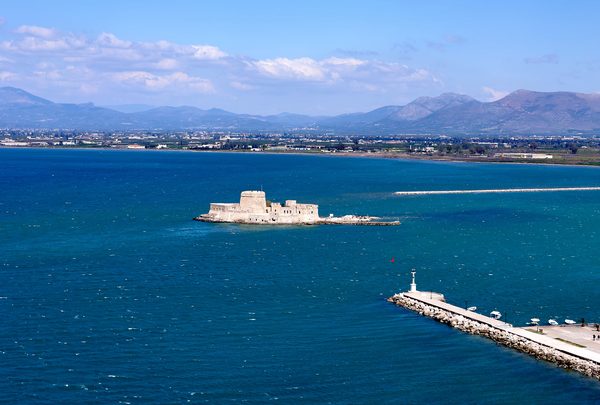
The old town is a grid of neoclassical mansions, Venetian balconies, Ottoman fountains, and small squares shaded by plane trees. Syntagma Square is the centre, overlooked by the building that housed the first Greek parliament. The Bourtzi, a small Venetian fortress on an islet in the harbour, is the town's postcard image.
For lunch, the back streets behind the waterfront have tavernas serving Argive specialties: stuffed peppers, lamb with artichokes, local wine from Nemea, 30 minutes south (see the Nemea wine region guide if wine is your thing). Budget 15--22 EUR for a full lunch.
If energy permits, climb the 999 steps to the Palamidi Fortress, the massive Venetian castle crowning the town at 216 metres. The views from the top cover the entire Argolic Gulf, Nafplio's terracotta rooftops, and the mountains of Arcadia beyond. Allow 30--45 minutes up, 20 minutes down. Bring water.
Afternoon Option: Epidaurus Instead of (or After) Nafplio
If ancient theatre moves you more than Venetian architecture, swap Nafplio's afternoon for Epidaurus, 30 minutes east. The 4th-century BC theatre seats 14,000 and has acoustics that science still cannot fully explain: a coin dropped on the stage is audible from the back row, 60 metres away. Standing at the top and hearing a whisper from the stage is one of those experiences that short-circuits scepticism.
The broader Sanctuary of Asklepios, the most important healing centre in the ancient world, surrounds the theatre. Tickets: 20 EUR. Full details in the Epidaurus day trip guide.
Return to Athens (16:00--18:00)
The drive back through the Argolid passes orange and olive groves, with the Saronic Gulf appearing on the left as you approach the Corinth Canal. If time allows, stop at the canal bridge for five minutes. The 6 km cut through solid rock is an engineering spectacle, even in passing. For a deeper stop, see the Ancient Corinth day trip guide.
Arrive back in Athens by early evening. For your final dinner, return to the neighbourhood you liked best (Koukaki, Petralona, Psyrri) and eat without an agenda. You have earned it.
What If You Want to Swap Days?
The three day trips above are my strongest recommendations for a five-day itinerary, but Athens has enough nearby to fill two weeks. Here are the alternatives worth considering:
Cape Sounion and the Temple of Poseidon. A half-day trip to the cliff-top temple south of Athens, combinable with a swim along the Athens Riviera and a soak at Lake Vouliagmeni. Best as a swap for Day 3 if you have already visited Greek islands.
Meteora. Monasteries perched on sandstone pillars in central Greece. More dramatic than Delphi visually, though the archaeology is less significant. Guided tours run 60--105 EUR. The main drawback is the 4--5 hour drive each way, making for a 13--14 hour day. A swap for Day 4 if you have already seen Delphi.
Athens wine country. The vineyards of Attica and Nemea are surprisingly close. Full-day wine tours run 70--120 EUR. A swap for Day 3 if islands do not appeal, or for Day 5 if you would rather drink than climb fortress steps.
Beach day. After four days of sightseeing, an entire day on the coast is a legitimate choice. The Athens Riviera beaches are accessible by tram and bus from central Athens, no car needed. Combine with Lake Vouliagmeni for the thermal mineral water.
Ancient Nemea. The site of the original Nemean Games, with a stadium where you can still run on the ancient track. Combines naturally with the Nemea wine region.
For the complete rundown, see best day trips from Athens.
How Much Will Five Days Cost?
Athens remains one of the most affordable capital cities in southern Europe. Here is a realistic per-person breakdown at mid-range level:
Accommodation (5 nights)
| Type | Nightly rate | 5-night total |
|---|---|---|
| Hostel dorm | 20--35 EUR | 100--175 EUR |
| Budget hotel / apartment | 55--90 EUR | 275--450 EUR |
| Mid-range hotel (Koukaki, Thisseio) | 90--150 EUR | 450--750 EUR |
Daily Costs
| Category | Day 1 | Day 2 | Day 3 | Day 4 | Day 5 |
|---|---|---|---|---|---|
| Site / museum entry | 70 EUR | 20 EUR | -- | 20 EUR | 20 EUR |
| Day trip transport | -- | -- | 70 EUR* | 65 EUR** | 65 EUR** |
| Meals (lunch + dinner) | 30--40 EUR | 30--40 EUR | 30--40 EUR | 15--20 EUR*** | 25--35 EUR |
| Coffee / snacks | 5--8 EUR | 5--8 EUR | 5--8 EUR | 5--8 EUR | 5--8 EUR |
| City transport | 2 EUR | 5 EUR | 5 EUR | -- | -- |
| Daily total | 97--110 EUR | 52--65 EUR | 110--125 EUR | 100--115 EUR | 107--120 EUR |
Hydra return ferry. Three-island cruise would be 100--130 EUR instead. Guided tour price including transport. Car rental splits to approximately 35--40 EUR/person (fuel + tolls + hire). **Lunch often included in guided Delphi tours.
Five-day total (excluding accommodation): approximately 465--535 EUR per person.
With a mid-range hotel, expect a total trip cost of roughly 950--1,300 EUR per person for five days, excluding flights. For strategies to bring this down, see Athens on a budget and free things to do in Athens.
The 5-day transport ticket at 8.20 EUR covers unlimited metro, bus, and tram rides within Athens. It is the best deal if you are not renting a car for city days.
What Should You Know Before Going?
Book the Acropolis early. Timed entry at tickets.hh.gr is mandatory, daily visitor numbers are capped, and summer morning slots sell out days in advance. Book the earliest morning slot as soon as your dates are confirmed.
There is no combined ticket. The old multi-site combo pass was discontinued in 2025. Budget 70 EUR for Day 1 archaeological entries alone (Acropolis 30 + Ancient Agora 20 + Roman Agora 10 + Kerameikos 10) or pick the sites that interest you most. Kerameikos closes at 15:00 from November to March, so plan it for the morning in winter.
Book day trips in advance. Delphi, Meteora, and Nafplio tours fill up in peak season. Ferry tickets to Hydra should be booked online for summer weekends. Independent travellers renting a car should reserve at least a week ahead.
Base yourself in Koukaki or Thisseio. Both neighbourhoods are within walking distance of the Acropolis and Day 1--2 sites, on metro Line 2 (Acropoli station), and have more restaurants aimed at residents than at visitors. Avoid Syntagma and Plaka for a five-night stay. The noise and tourist pricing wear thin.
Shoes matter every day. Acropolis marble is polished smooth, Delphi paths are mountain terrain, Palamidi is 999 stone steps, and Hydra's town is steep stairways. Comfortable walking shoes with good grip are non-negotiable.
Carry cash. Bakeries, kiosks, ferry ticket booths, water taxis on Hydra, and monastery entry at Meteora often require cash. Keep 30--50 EUR on hand.
Best months: April--May and September--October. Warm enough for island swimming, cool enough for comfortable sightseeing, without the 35--40C heat and peak-season prices of July--August. For detailed seasonal guidance, see best time to visit Athens.
Getting from the airport: The metro runs directly from Athens International Airport to Syntagma (40 minutes, 9 EUR). See the Athens airport to city center guide for all options including bus, taxi, and private transfer.
The metro is your best friend. Three lines cover most of the city, and several stations double as archaeology museums with excavated finds displayed behind glass on the platforms. See the Athens metro guide for routes and tips.
For packing advice tailored to the mix of city walking, archaeological sites, and island hopping in this itinerary, see what to pack for Athens.
This itinerary covers approximately 12--15 km of walking on Days 1 and 2, a ferry crossing on Day 3, and 500+ km of road travel across Days 4 and 5. The Acropolis opens at 08:00 year-round (it closes at 20:00 in summer and 17:00 in winter). Delphi and Peloponnese sites open daily at 08:00--08:30. Hydra ferries run year-round, most frequently May through October. For the shorter versions, see the one-day, two-day, three-day, and four-day Athens itineraries.
Planning more adventures from the capital? Browse our complete guide to the best day trips from Athens.
Last updated: 1 October 2026