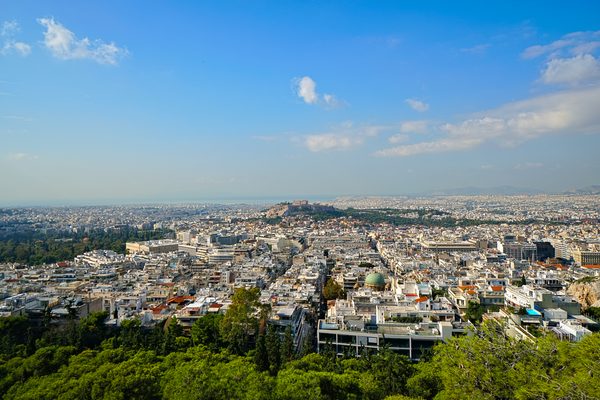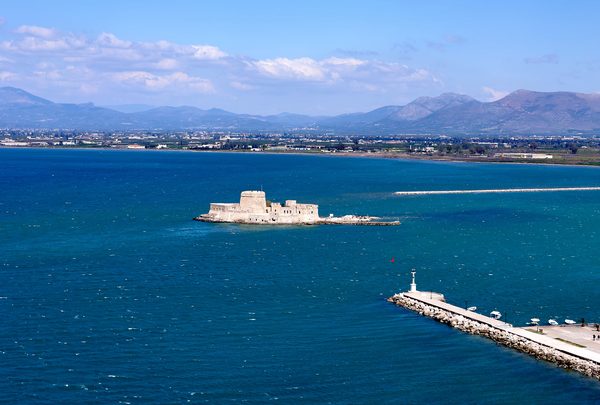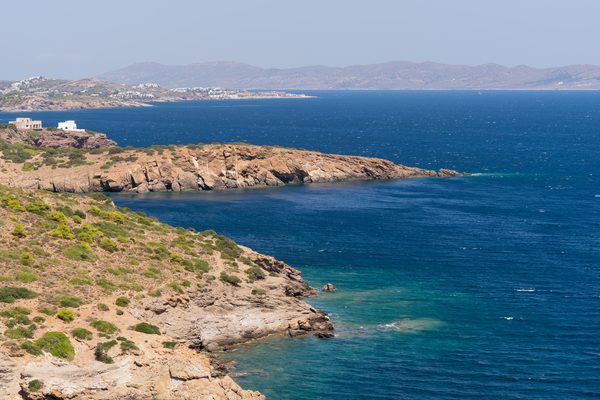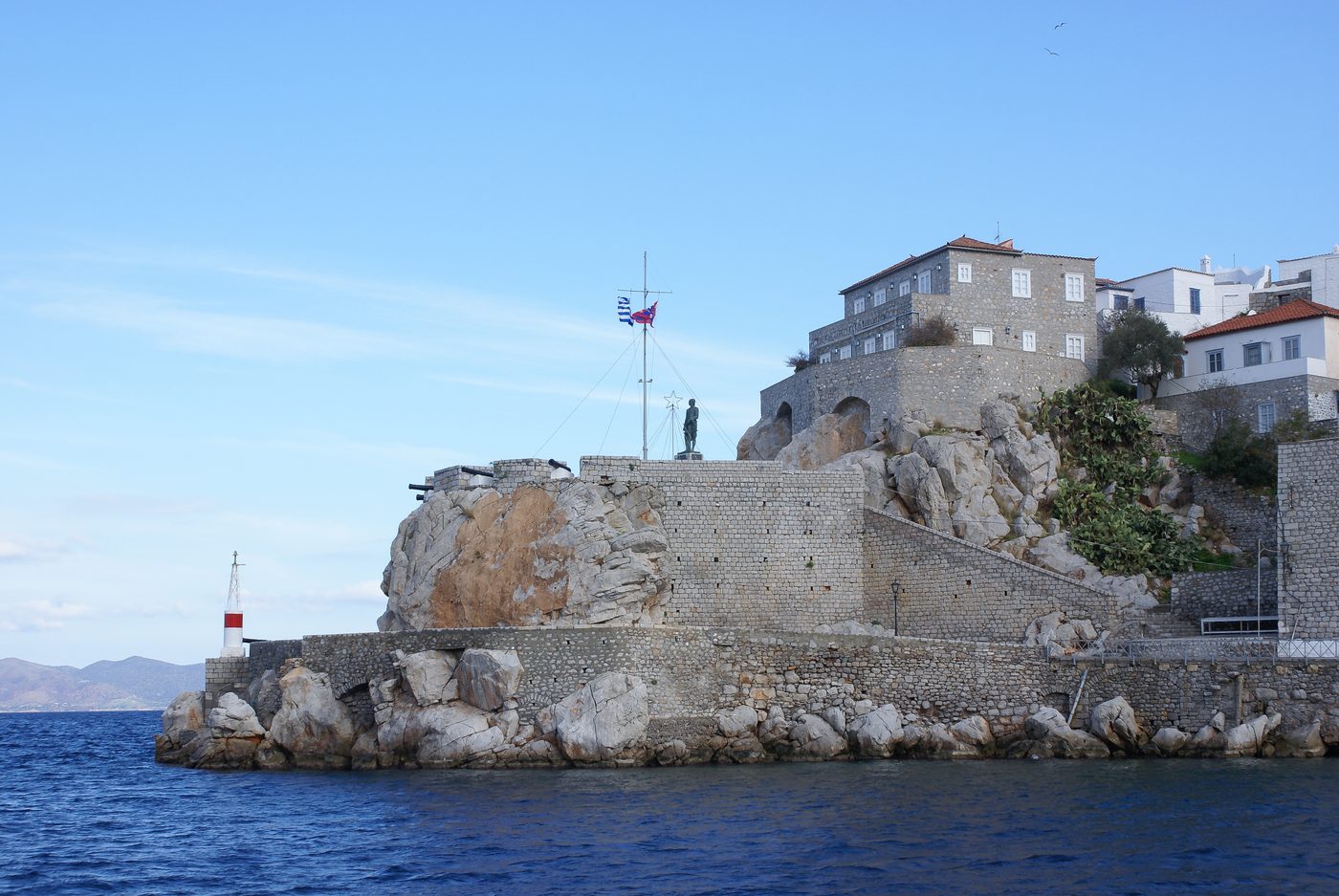
Four days is the luxury version of Athens. You have enough time to linger where others hurry, to reach the museums and neighbourhoods that shorter itineraries sacrifice, and to leave the city twice: once for the cliff-top temple at Cape Sounion, and once for the car-free island of Hydra.
In this guide
Most visitors treat Athens as a one-day obligation before catching a ferry. That is a waste. With four days, you can spend an entire morning with the Mycenaean gold at the National Archaeological Museum without glancing at your watch, sketch the Tower of the Winds while tour groups jog past, and eat grilled sardines on an island with no roads. I have been building this itinerary for friends and family since I moved here in 2015, and it is the version I am most proud of.
Day 1: The Heart of Ancient Athens
Morning: The Acropolis (08:00-10:30)
Arrive before the gates open. The security queue forms by 07:45 in summer, but these early risers are rewarded with silence on the Sacred Rock. The only sounds are footsteps on marble and wind channelling through the Propylaea.
Rather than racing to the Parthenon, turn left after the gateway and walk to the southern edge. Below sits the Theatre of Dionysus, the birthplace of Western drama. The carved thrones in the front row, reserved for priests and dignitaries, are still visible, each inscribed with its occupant's title. Aristophanes mocked politicians from this stage. Euripides staged Medea here.
Approach the Parthenon from the south-east corner. Most visitors see it from the west, but this angle gives you the full length of 46 outer columns receding in perspective. Notice how the stylobate (the platform) bows upward by about 6 centimetres at the centre. Combined with the slight inward lean of the columns, these optical corrections make the building appear perfectly straight from a distance. Engineering in service of illusion, calculated 2,500 years before computers.
Walk the full circuit to the Erechtheion and its Caryatid porch (casts, with the originals in the museum below). Look at the rock beneath your feet: limestone scarred with ancient cuttings, post holes, and worn paths marking three thousand years of continuous use.
Tickets: 30 EUR (year-round). Timed entry is mandatory. Book your slot in advance at tickets.hh.gr. Entry is by hourly time slot and daily visitor numbers are capped.
Late Morning: Acropolis Museum (10:30-12:30)
With four days, you have a second museum morning later, so use this visit strategically. Start with the Gallery of the Slopes: surgical instruments, cooking pots, clay lamps displayed alongside the excavated neighbourhood visible through the glass floor. A reminder that people lived in the shadow of the Parthenon, not just worshipped there.
The Archaic Gallery deserves slow attention. The korai still carry traces of original pigments: red lips, blue drapery. The Peplos Kore, displayed alongside her digitally reconstructed painted version, shatters the myth of monochrome antiquity. The top-floor Parthenon Gallery, with surviving frieze sections mounted in their original positions and plaster casts filling the gaps where the British Museum's portions belong, lets the absence speak for itself.
Tickets: 20 EUR. No advance booking required for individuals.
Lunch: Thisseio (12:30-14:00)
Walk west along Dionysiou Areopagitou beneath the Acropolis. Find a table on Apostolou Pavlou or the quieter Iraklidon Street behind it. Thisseio has one of the best Acropolis views in Athens. The Parthenon sits directly above the rooftops. Greek salad with barrel-aged feta, kolokithokeftedes (courgette fritters), 12-18 EUR. Better value than anything in Plaka.
Afternoon: Roman Agora, Tower of the Winds, and Hadrian's Library (14:30-16:30)
The section most short itineraries sacrifice. Athens did not end with Pericles. The city had a substantial second act under Roman rule.
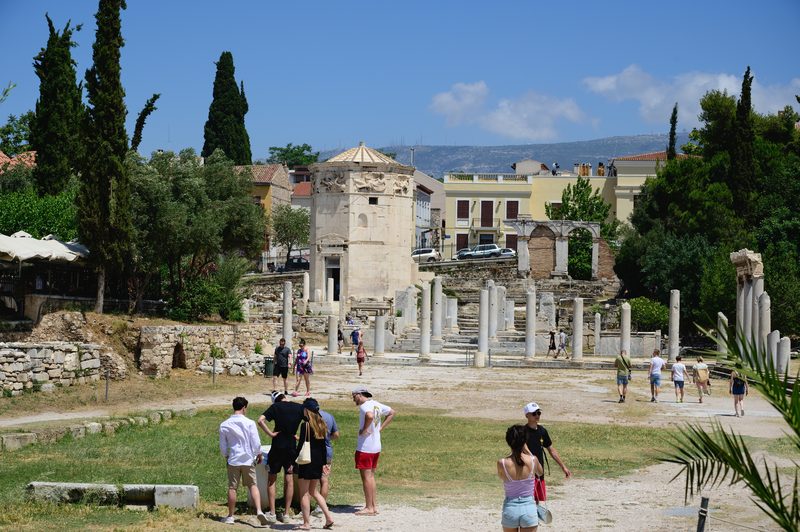
The Roman Agora was a 1st-century BC commercial marketplace with a grand entrance gate donated by Julius Caesar and Augustus. The Gate of Athena Archegetis still stands, inscribed with its Roman sponsors' names.
The Tower of the Winds alone is worth the detour. Built in the 2nd century BC by the Syrian astronomer Andronikos Kyrrhestes, this octagonal marble tower functioned as a sundial, water clock, and weather vane simultaneously. Each face carries a carved wind god: Boreas wrapped in a heavy cloak, Notos pouring rain. The world's first known meteorological station, and it was working when Christ was born.
Hadrian's Library opposite, built in 132 AD, housed scrolls, lecture halls, and a garden courtyard. Its towering Corinthian columns are the most visible Roman structure left in Athens.
Tickets: Roman Agora 10 EUR, Hadrian's Library 10 EUR. Buy at each site or in advance at tickets.hh.gr.
Late Afternoon: Kerameikos Cemetery (16:30-17:30)
Kerameikos is open daily, but the closing time shrinks through the year: 20:00 in summer, 18:00 by late October, and 15:00 from 1 November to 31 March. Last admission is 20 minutes before closing. Check hh.gr for current hours.
This is the most overlooked major archaeological site in Athens, and you may have it entirely to yourself. The monumental tombs lining the Street of the Tombs are extraordinary: carved marble bulls, weeping sirens, a relief of a young soldier saying farewell to his father. These are real people memorialised in stone, and the emotion is startlingly direct. Tortoises wander the pathways. Wild flowers grow between tombs in spring. After a morning of crowds on the Acropolis, the contemplative atmosphere is welcome.
Tickets: 10 EUR.
Evening: Metaxourgeio (19:00 onwards)
Skip the tourist circuit and head to Metaxourgeio, north-west of Monastiraki. Converted workshops and neoclassical townhouses now host wine bars and experimental Greek cooking. The streets around Plateia Avdi are the centre of it: smoked aubergine with pomegranate, slow-cooked pork cheeks, natural Greek wines. Dinner with wine: 25-35 EUR per person. This is the Athens that Athenians are most excited about right now.
Day 2: Deeper Athens
Morning: National Archaeological Museum (09:00-12:30)
The museum that shorter itineraries mention but never give proper time. Twenty minutes north on foot, or metro to Victoria. Inside: the most important collection of Greek antiquities on earth. You cannot see all 50 rooms in one morning, and you should not try. Here is what matters.
Room 4, Mycenaean Collection: Death masks, inlaid daggers, gold cups worked with scenes of bulls and hunts. The Mask of Agamemnon sits at the room's centre. Whether it depicts the legendary king is debatable, but the beaten gold face is one of the most recognisable objects in archaeology. The Vapheio Cups, decorated with bull-catching scenes, are arguably even finer work.
Room 15, the Poseidon/Zeus Bronze: A life-sized figure hurling a weapon, recovered from a shipwreck in 1928. One of a tiny number of original Greek bronzes to survive antiquity. This single statue justifies the museum.
Room 38, the Antikythera Mechanism: The world's first known analogue computer, built around 100 BC. A corroded lump of bronze gears that tracked the sun, moon, five planets, and predicted eclipses. Nothing of comparable complexity appeared again for over a thousand years.
The Cycladic Collection: Marble figurines from the 3rd millennium BC: abstract, minimalist, hauntingly modern. Brancusi and Modigliani were both influenced by them.
Tickets: 20 EUR (reduced 10 EUR). Allow 2.5-3 hours.
Lunch: Plateia Viktorias (12:30-14:00)
The streets near the museum have unpretentious neighbourhood restaurants: grilled meats, oven-baked dishes behind glass, barrel wine. Full lunch for 10-14 EUR. For something different, walk east to Kypseli, a multicultural neighbourhood where the bougatsa on Fokionos Negri is outstanding.
Afternoon: Free Choice (15:00-17:30)
Three options depending on your mood:
Option A: Monastiraki Flea Market. Antique dealers, junk shops, vintage records around Avyssinias Square. Old copper, Byzantine icons, midcentury furniture. Haggling expected.
Option B: Benaki Museum of Greek Culture. Greek civilisation from prehistory to the 20th century through an exquisite private collection. Manageable in 1.5 hours. Tickets 12 EUR.
Option C: An Athens food tour. Guided afternoon tours through the Central Market reach places you would never find alone. Budget 60-80 EUR.
Evening: The Acropolis View Walk and Dinner
Walk the full pedestrian promenade from the Acropolis Museum west through Dionysiou Areopagitou and Apostolou Pavlou to Thisseio. In the hour before sunset, the Parthenon shifts from white to gold to amber. Street musicians set up along the route. At Thisseio, find a spot where the view opens across the Ancient Agora to the floodlit rock.
For dinner, try the backstreets of Petralona: lamb chops, horta with lemon, a bottle of Nemean red. Dinner for two with wine: 40-55 EUR.
Day 3: Cape Sounion and the Attic Coast
The Drive South (09:30-11:30)
After two days of walking, a morning with coffee and a slow drive is exactly right. Take the coastal road through the Athens Riviera: Glyfada, Vouliagmeni, Varkiza. Once past Glyfada, the suburbs thin, the shoreline turns rocky, and the water shifts from harbour grey to transparent blue-green.
Stop at Lake Vouliagmeni, a collapsed sea cave filled with mineral-rich thermal water at 22-29 degrees year-round. Entry 15-18 EUR. The silky mineral water and the small fish that nibble dead skin from your feet are unlike anything else.
The Temple of Poseidon (12:00-14:00)
Most visitors arrive for sunset, so a midday visit gives you the site virtually alone. For photography, this is the better choice. Morning light hits the columns from the east, warming the marble and casting sharp shadows. At sunset the temple becomes a silhouette, dramatic but lacking detail.
Fifteen columns remain standing on a headland 60 metres above the sea. The architect used slimmer proportions than the Parthenon's, giving the temple an elegance suited to its exposed clifftop. Walk the Peloponnesian War fortification walls on the north and east sides for viewpoints over coves where ancient warships sheltered. To the south, the islands of Kea and Kythnos mark the first stepping stones toward the Cyclades.
For the full history, see the complete Cape Sounion guide.
Tickets: 20 EUR. Open daily from 09:30 until sunset.
Lunch and Return (14:00-17:00)
Skip the overpriced tavernas at the site entrance. Drive ten minutes north toward Lavrio, where waterfront fish restaurants serve the local catch at half the cost.
On the return, stop at a beach between Varkiza and Vouliagmeni for a late-afternoon swim. The Athens Riviera coast is clean and warm from June through October. Tonight, eat simply: souvlaki near Monastiraki, or meze in Psyrri. Save your appetite for the island tomorrow.
Day 4: Hydra Island
Morning: The Ferry (08:00-10:00)
Metro Line 1 to Piraeus (25 minutes), then Gate E8 or E9 for Saronic Gulf ferries. High-speed crossings take 70 minutes to two hours, costing 30-42 EUR each way. Book in advance during summer weekends. For complete details, see the Athens to Hydra guide.
Hydra Town (10:00-12:00)
The harbour opens up as the ferry rounds a headland: a crescent of grey stone mansions, fishing boats at anchor, cafe tables on the quay. No cars, no motorbikes, no construction cranes. Hydra banned motor vehicles decades ago, and after three days in Athens the stillness is almost disorienting.
Walk into the back lanes. The town climbs steeply through stone stairways and whitewashed walls. The 18th-century captains' mansions, four storeys of dressed stone with carved doorways, were built by merchant fleet owners who made Hydra one of the wealthiest islands in Greece. The Historical Archive Museum explains why: Hydra's fleet was decisive in the Greek War of Independence, contributing more ships than any other island.
The Lazaros Koundouriotis Mansion above the harbour has been restored with period furnishings. The terrace views alone are worth the steep climb.
Afternoon: Beach, Swim, Lunch (12:00-16:00)
After three days of archaeology, a few hours of swimming and grilled fish is not laziness. It is balance.
Walk to Kaminia (15 minutes) or continue to Vlychos (40 minutes), a cove with sunbeds, tamarisk shade, and tavernas at the water's edge. Water taxis reach Vlychos in five minutes for 10-15 EUR if walking feels like too much.
Lunch at a Vlychos taverna: grilled octopus, fried calamari, village salad. Or return to Hydra town for a harbour-side table where boats rock gently beside you. Try the amygdalota, Hydra's almond pastries.
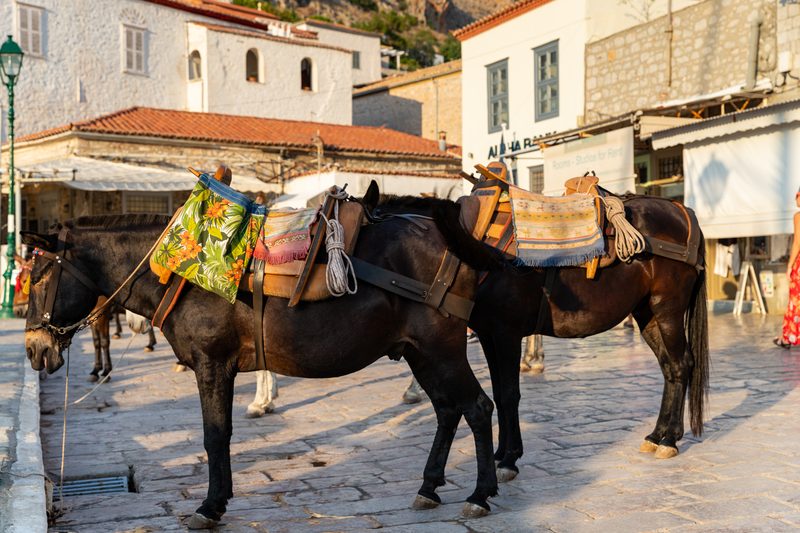
The contrast is the point. Athens gives you density; Hydra strips it away. Donkeys carry supplies, cats sleep on warm stone, church bells echo off the harbour walls. This is the Greece between the monuments, and it makes the four-day itinerary feel complete in a way a third archaeological site never would.
Return to Athens (17:00-19:30)
Evening ferries run between 16:30 and 19:00. The return crossing, with the sun lowering over the Peloponnese, is even more beautiful than the morning trip. Metro back to central Athens in 25 minutes.
Where to Stay
Koukaki is the strongest base for four days. Residential, well-connected (Acropoli metro), walking distance to everything on Days 1-2, and the restaurants are aimed at people who live there rather than at passing visitors. Mid-range hotels 90-150 EUR; apartments from 55-80 EUR.
Thisseio is worth considering for its immediate access to the pedestrian promenade, Ancient Agora, and Kerameikos.
Avoid Syntagma and Plaka for a four-night stay. The noise and tourist pricing wear thin after two nights.
Budget Breakdown
Rough daily costs per person, mid-range:
| Category | Day 1 | Day 2 | Day 3 | Day 4 |
|---|---|---|---|---|
| Acropolis | 30 EUR | -- | -- | -- |
| Acropolis Museum | 20 EUR | -- | -- | -- |
| Roman Agora + Hadrian's Library | 20 EUR | -- | -- | -- |
| Kerameikos | 10 EUR | -- | -- | -- |
| National Archaeological Museum | -- | 20 EUR | -- | -- |
| Cape Sounion entry | -- | -- | 20 EUR | -- |
| Lake Vouliagmeni (optional) | -- | -- | 16 EUR | -- |
| Hydra ferry (return) | -- | -- | -- | 70 EUR |
| Car rental Day 3 (split between 2) | -- | -- | 20 EUR | -- |
| Fuel | -- | -- | 10 EUR | -- |
| Meals (lunch + dinner) | 30-40 EUR | 30-40 EUR | 25-35 EUR | 30-40 EUR |
| Coffee / snacks | 5-8 EUR | 5-8 EUR | 5-8 EUR | 5-8 EUR |
| Metro / transport | 5 EUR | 5 EUR | -- | 5 EUR |
| Daily total | 120-135 EUR | 52-65 EUR | 96-110 EUR | 110-125 EUR |
Four-day total: approximately 380-435 EUR per person, excluding accommodation and flights.
What Should You Know Before Going?
- Book Acropolis timed entry at tickets.hh.gr. It is mandatory. Daily visitor caps apply and summer slots sell out. Other archaeological sites (Roman Agora, Hadrian's Library, Kerameikos) can be bought individually at each site or online.
- Site entry adds up. With no combined ticket available, budget 60 EUR for Day 1 archaeological sites alone (Acropolis 30 + Roman Agora 10 + Hadrian's Library 10 + Kerameikos 10).
- Shoes matter every day. Acropolis marble is polished smooth, Sounion paths are rough rock, Hydra's town is steep stone stairways. Trainers or walking sandals with good grip.
- Water and sun protection from May through October. Archaeological sites have almost no shade. Athens tap water is safe, so carry a refillable bottle.
- Best months: April-May and September-October. July-August work but expect 35-40C and higher prices.
- Cash: Carry 30-40 EUR. Ferry kiosks, bakeries, water taxis on Hydra, and the flea market often do not accept cards.
- The Athens 5-day transport ticket (8.20 EUR) covers unlimited metro, bus, and tram rides. The best deal for a four-day stay.
- Hydra ferry booking: Reserve online in summer. Arrive at Piraeus 45 minutes early. The port is enormous and poorly signposted.
Alternative Day 4 Options
Hydra is my recommendation because it provides a complete change of pace. But three strong alternatives exist:
Delphi. The most spectacular archaeological site in mainland Greece, 2.5 hours by car, with lunch in the mountain village of Arachova. Best for maximising ancient history.
Aegina. The closest Saronic island (40 minutes by ferry). Less dramatic than Hydra but with the superb Temple of Aphaia, pistachio groves, and a working fishing harbour. Easier logistics and cheaper ferries.
Epidaurus. The ancient theatre with the most famous acoustics in the world. Drop a coin on the stage and hear it from the top row. Combines well with Ancient Corinth or the Corinth Canal.
For the complete rundown, see the best day trips from Athens.
This itinerary covers approximately 10-14 km of walking on Days 1 and 2, a 160 km round trip on Day 3, and a ferry crossing on Day 4. The Acropolis opens at 08:00 year-round (it closes at 20:00 in summer and 17:00 in winter). Sounion opens daily at 09:30. Hydra ferries run year-round, most frequently May through October.
Planning more adventures from the capital? Browse our complete guide to the best day trips from Athens.
Last updated: 1 October 2026